There is an evolution in our painting of skies and clouds over the last 500 years. Until about 1880 we were concerned with mimesis, the faithful imitation of nature. We had evolved painting away from iconic signs toward a stronger correlation with our visual experience. After 1880 our appreciation of invention in art no longer came from a faithful correspondence with visual experience and memory but rather, from our exploration of materials, from the acceptance of the eye as an instrument of the mind and, from revelations of mental activity especially, from our unconscious activity as a new source for painting content and innovation. This modern attitude of a re-directed quest for invention altered the course of painting skies as it would everything else. I begin with the tradition that has most influenced us today, European painting, Dutch and Italian painting from the late 15th century. In the late 1400s skies were often seen as a territory to be associated with the heavens ( a Medieval inheritance) , the air and, to be a theatrical backdrop providing deep space for the picture’s subject. As you see here in this crucifixion scene from Hans Memling’s circle of artists, the clouds are clearly individuated, autonomous, lightly shaded in the center and brighter on the top edges. The shapes are rounded, repetitive and, the clouds appear more as symbols of clouds than observed.  Further South, in Italy, Cima da Coneglio was painting clouds in clusters yet, still iconic, still soft rounded repetitive shapes in symmetrical flanking support of the subject, the Madonna ( see detail and full image example)
 In both of my 15 century examples the clouds’ illumination does not match with the light source. The horizon appears to offer the greatest light source until we look at the clouds and see that they are lit from above and, from the left which is more like the illumination on the subject but, not completely in harmony with the subject which appears to also have its own stage lighting. In the next century, Veronese would find poetry in linking the shapes of clouds, negative sky shapes, and the leaves silhouetted against them ( see example of detail from a Veronese)
  The clouds are still stylized, not the result of a unified personal observation of the subject in front of nature. They are still a theatrical backdrop, a stage set whose design is meant to provide contrast, design unity, and a reference to deep celestial space. As I move into the 1600s the role of the sky is more of the same, to provide enhanced dramatic and structural unity. The paintings are not yet painted as a result of direct observation but, the consequence of studio invention coupled to remembered natural skies and remembered paintings.. The sky in this Jacob Van Ruisdael of the mid 1600s shows a bright pyramid of illumination(clouds) drawing our attention to the center of the painting.
 Now the sky, cloud shapes, receive more attention as they become flanked by framing trees. The clouds’ goal now is to participate equally with the rest of the painting in delivering a heightened piece of dramatic natural theater. The light on the clouds and earth now appear more reconciled than earlier. Rubens, (earlier in the 1600s, 1610 in the example) would use clouds and skies as a theatrical device for melodramatic emphasis. In this seascape the clouds and sea co-mingle in the wild turbulence. The clouds part to provide theatrical illumination. Later, his influence was rejuvenated by French Romantic artists like Delacroix and Gericault and, as late as the Barbizon period in the mid 19th century. the first example is Rubens and second is a study by Theodore Rousseau 250 years later.
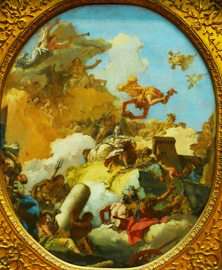
 The observation of nature has increased in the Rousseau but, there is still the same concentric design structure, theatrical back-lighting, and chiaroscuro drama. In the 18th century, especially in Venice artists push the dramatic use of clouds into greater and less cloud-like exaggerations. Piazzetta and Tiepolo use clouds like architecture, clothing, or earth formations, as solid forms capable of suspending massive material in a heavenly setting or able to interweave with architectural scenes on earth. These clouds continue to perform the duties of design, integrating and cohering the disparate elements of the composition with their form. They also carry the associations with the supernatural with them, surrounding and supporting whatever they envelop. Their edges are linear with their interior shape being modeled for volume. (Example is a Tiepolo)
 By the mid 1700s artists like Canaletto and Guardi are pursuing a more evanescent light, a natural feeling of early morning or sunset. They needed more observation, more nuanced clouds. Finally, we have clouds that feel vaporous. They are subordinate to supporting the theme of the painting while their structural design role is diminishing. Here is an example of Guardi’s work.
  . He was lucky to have Canaletto called to London on commission work leaving much of the Venice’s market to him in the 1750s. In my next blog I will follow skies and clouds through the 19th century, into the 20th, and eventually bring us up to this moment with predictions for the future.

Fredic Neuwith
Greatblog! Never thought about “CLOUDS” in a historical and or religious context.
Tania
Very interesting blog topic, I had not given much thought to clouds back through history and the way the artist used or painted them. I’m looking forward to the next installment. Thank you.