
When a culture wants pictographic information or symbolic images then stability and clarity matter most. As soon as artists (classic Greek artists were first) wished to describe the action and reaction between characters then, instability becomes a goal. Eventually instability couples with uncertainty (ambiguity) for a new effect because, together they evoke greater motion and a broader range of interpretations. The evolution evoke motion and active interaction between characters was slow to develop. After the fall of Rome, Gombrich notes that art resumed its symbolic function until the Renaissance rediscovers persuasive, natural, dramatic interaction.
As the Renaissance unfolded into the Baroque, artists like Caravaggio continued their interest in instability as an enlivening force in painting. His figures interact as they gesture, turn, and lean (see example 1). By the 1700’s the Rococo influence in Venice had liberated artists like Francesco Guardi to experiment with loose bravura paint gestures to describe his figures. His brushwork suggests movement (see example 2).
Example 1. Caravaggio.
Example 2. detail from a F. Guardi painting.
In Persia artists pursued the narrative power of instability in the 16th century while working on small images in watercolor, ink, gold and silver on paper. Example 3 is a detail from “The Battle of Pashan Begins” by Abd al-Vahhab and Muzafar ‘Ali . Later European modernists would see these works as they searched other cultures for inspiration. In this early 20th century painting by Andre Derain notice how the palette, graphic shapes, and interaction of the figures share dramatic action and interdependent instability as in the Persian painting (example 4).
example 3. Persian mid 1500s
example 4. Derain 1908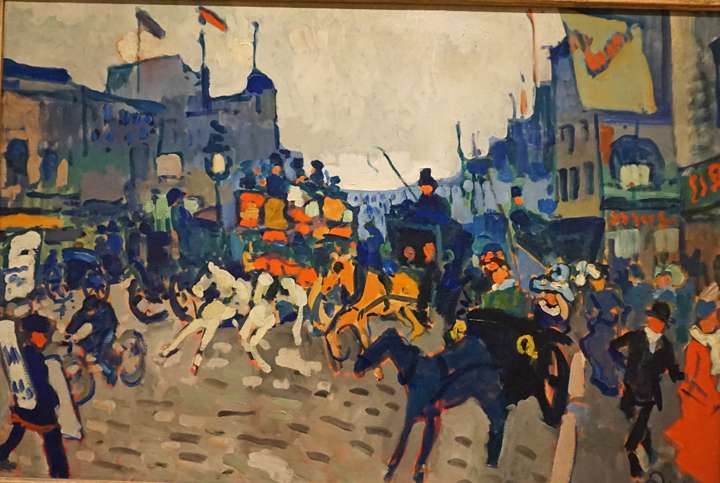
As I try to evoke figures in motion I look to sources like the Persians, or Guardi, or Derain. The following examples are step-by-step demonstrations of how I balance stability and instability and, clarity and ambiguity within a painting. Example 5 uses linear perspective principles as well as composition precedents set by Cubists like G. Bracques. Example 6 presents step two of the same image. In this image you see how I have strengthened linear perspective in the foreground which helps ground the shadow sweeping across the bottom of the image. I also simplified the tone and color of the figures on the right. Earlier they were too confused to be effectively suggestive.
example 5. step one, Times Square
example 6. step two, Times Square
In examples 7 and 8 I again look for a balance between instability and stability and, between clarity and ambiguity. In step one (example 7) the secondary figures are too blurred and awkward to solicit our sustained attention. The central street level area is too ambiguous or confused to attract us. In step two (example 8) I have introduced new figures to the central area. They appear to be interacting. On the left side the figures have become more legible but, still uncertain. They are grouped to suggest modes of interaction. The large forward blurred figures continue to move the action into the painting.
example 7. step one of Caught in Rain
example 8. step two of Caught in Rain
My last image presents a horizontal array of images. They move in and across the painting. Classically, horizontal friezes of figures were often depicted on sarcophagi or on triumphal arches. The action figures moved left to right. Here, I have the figures lined up horizontally but their motion indicates a movement to and from the viewer. The central protagonist moves into the image ( example 9)
example 9. Horizontal Array
I invite you to visit an exhibition of my paintings which includes a couple of the examples you’ve seen here. The opening reception is this Friday, May 15,2015 at the Susan Powell Gallery in Madison, Connecticut from 5 to 8:30 PM. The Show runs until June 15. The Gallery’s address is 679 Boston Post Road in Madison,Ct. 203 318 0616.
Fredric
Example 9 the central Figure look like they are dancing. Perhaps more motion as some of the other shapes can be dancing
Exciting idea ‘
Example 8 needs more rain to feel wet
How you achieve this I have no idea
Fredric neuwirth
Example 9 central figures are ready to dance. They need to be put in motion along with other groups
Example 8 rain The rain needs to more obvious I am not sure how to accomplish this. Wet pavement & reflections
Fredric neuwirth
Example 9 central figures are available ready to dance. They need to be put in motion along with other groups
Example 8 rain The rain needs to more obvious I am not sure how to accomplish this. Wet pavement & reflections