
I was in sixth grade when I felt the dangerous magnetism of big falls. I was close to the rail staring at the downward plummet of Niagara. It pulled on me. Always an inviting peril, the emotionally charged attraction of waterfalls compel attention. Their movement, their promise of journey, and their sparkle are fundamental ingredients to catch our eye.
A thousand years ago during China’s Sung dynasty the artist, Fan Kuan painted the quintessential mountain landscape, an oil on silk. He framed a small waterfall at the bottom of the mountains. The falls bounce in steps to a stream below (example 1). He had seen other artists paint falls, he had a schematic in mind. Fast forward to Hokusai in Edo Japan in 1832. He still uses the same design structure to render his falls, a zig zag pattern with the top taller than the bottom (example2). Travel to England at that time and you discover J.M.W. Turner painting falls in watercolor across the English countryside (example 3). His falls also follow the bouncing zig zag. For Asians the zig zag designs represents the dragon for Mediterranean artists it presents the serpent, the life giving serpent in Eden’s garden.
In 1827 Michallon was painting a favorite sight of landscape painters, the waterfall gorge at Tivoli just outside Rome. He did not depict the tallest falls but chose an intimate close-up of shallower falls in his plein air oil study (example 4). His falls follow the zig zag. Michallon instructed Corot who would influence Courbet and then the later Impressionists.
example 1. detail of falls from Fan Kuan, see inside superimposed green lines.
example 2. Hokusai’s Falls.
example 3.Turner’s Falls.
example 4. Michallon’s Falls.
Recently we have experienced heavy spring rains in Connecticut. I explored nearby Nature Conservancy trails seeking freshly invigorated falls (example 5). Back in my studio I reconsidered a series of the photographs and, what redesign possibilities they offered me. Next, I selected a small rectangle of brushed silver anodized aluminum. Then, I began as you see in step 1 (example 6). First, I applied a mixture of ultramarine blue with a light touch of gamboge yellow. In selected areas I added more carmine lake. Above this area I applied a mixture of gamboge, carmine lake, less ultramarine and a little titanium white.
example 5. Photo of Falls (after Photoshop enhancements).
example 6. Step one.
In step 2 (example 7) you see the effects of the translucent colors on the brushed silver. They give a golden luminosity to areas. I begin finding small tilts and slants with an opaque light tone using a flat two inch watercolor wash brush. I start at the top and work down from smaller to larger shapes regarding their cumulative impression and, their counterpoint interactions with adjacent shapes. I am working wet on wet, all at once ( alla prima). In step three (example 8). I sculpted contours of the cascading water using an oily white mixed with a note of vermillion. The white picks up some of the wet color beneath. I splay the ends of the brush to suggest rivulets. I invert the brush to suggest the kickback of water landing below a fall. The pattern follows the zig zag.
example 7. Step two.
example 8. Step three.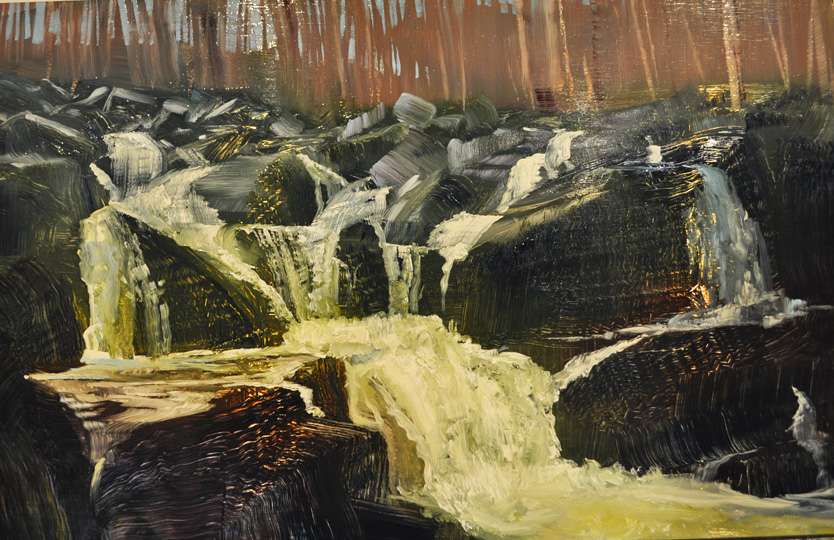
After this discussion of waterfalls you and I are now mentally preconditioned to perceive even ambiguous information like Gerhard Richter’s abstract painting (example 9) as suggestive of falling water. My previous examples (steps one and two) also do not need to overtly present the edges of falling water as seen in example 8 (step three) because, they already suggest a context for a waterfall. Our mental preset prejudices our looking to expect and project the possibility of a waterfall.
example 9. Richter’s abstraction, a waterfall….
Patricia Scanlan
What a dynamic and informative look at waterfalls. Your painting makes one feel the splash and hear the water
Fredric Neuwirth
For some unknown reason your blog came in as spam. It took a while to find it. I love the history and evolution of the form. Great minds think alike. Hastings is filled with streams leading down to the Hudson. Unfortunately, my photographs are not as good as your example.
What you need to explain are the decisions you make in the color selection in order to find the image. It would be helpful.
William Child
Waterfalls of any size or force are inspirational to me and an artist’s joy to render! Love the Turner’s painting you posted here and admit I’d never seen it before, so thank you David! Example 5 reminds me much of a small but sometimes powerful falls, after heavy rains, that our family drove by hundreds of times back in the day.