
Experiment with a recipe, new ingredients, oven temperatures and your menu expands. Experiment with tools, paints, gestures, surfaces and your painting menu expands. Ideas are born from experiments. Merely repeating the recipe will not generate new dishes, new directions. What follows are a series of experiments which suggested new directions. I chose from the following experiments which direction to pursue as I enlarged the scale of the experiment. Do not prejudge the experiment. Follow it.
Example 1 gives a sample of my existing art historical menu. I begin with the complementary color traditions of the Impressionists and neo-impressionists, like Pierre Bonnard. To make a radiant painting he juxtaposed complementary colors often mixed with white for added opacity. The edges vibrate; some are indistinct and fuzzy. Fields of space and color comingle. For a vibrant yellow he contrasts a violet. He kept the values of yellow and violet close. This amplifies the luminosity of the color, the brightness and the saturation effects.
example 1. Pierre Bonnard.
My next examples begin with two demonstrations I made before two different classes. Each demonstration was an experiment of oil on paper made with 3 and 4 inch flats and, a short squeegee (which rendered the strong verticals suggesting tree trunks). They are both about 10×10″. I began example 2 with a yellow composed of gamboge and lemon yellows. I then overlaid and intercut violets varying intensities. In example 3 (my afternoon class demonstration) I used a red-orange as my first color. After assessing the effects I decided to make a larger work, 36×36, on canvas. I thought the yellow/violet effect offered a stronger opportunity for radiance. Example 4 is the first step in making the larger 36×36 canvas work. Example 5 presents the most recent step. Example 6 presents another example (36×34 oil on canvas) of the same type of violet/yellow radiance with a similar setting. By painting example 6 I wanted to see what happened if I lightened the palette still further.
example 2. 1st oil demo on paper.
example 3. 2nd oil demo on paper.
example 4. 1st step in larger painting.
example 5. 2nd step in larger painting.
example 6. Painting with lighter palette.
Smaller scale experiments allow for more experiments. The bigger they are (usually) the slower the process. Artists have scaled up their experiments for thousands of years from architecture, to sculpture to painting. To see their experiments alongside their finished works reveals the process of creation. Today we often prefer the spontaneity demonstrated in the small experiments over the more careful final efforts. Consider the expressive plein air studies of Constable and Corot versus the more formulaic effects of their finished works. Keeping the freshness of the experiment alive in the scaled up painting is difficult. Remember the value of reduction and simplicity.
My next experiments result from considering a NYC street scene. My original plan was to evoke motion and space. The design depended on simplicity, a simple vortex of light moved to the far right of the image. This is an offset hub-and-spoke design, a circling series of wedges all directed to the light and infinitely distant vortex. Example 7 is a the result of oil on joint-compound spread with over anodized aluminum. Example 8 is the result of oil squeegeed over an older painting. Example 9 is the larger oil on canvas. The first two examples are approximately 18×18. Example 9 is larger,36×34.
example 7. oil over joint compound (plaster).
example 8. oil with squeegee over painting. 
example 9. larger painting on canvas, brushes, rags and squeegees.
My last examples demonstrate again how to use a recent older painting as a substrate for a new painting and, the process of discovery through an evolving experiment. Here is a winter meadow with remnants of snow indicating a serpentine trail back into the distance. A series of serpentine patterns coalesce into one on the far right of the painting. Example 10 represents the painting to be used as the substrate. Examples 11, 12, and 13 represent intermediate steps where you see how the original substrate is exploited and subsumed into the new painting presented in example 14.
example 10. substrate painting.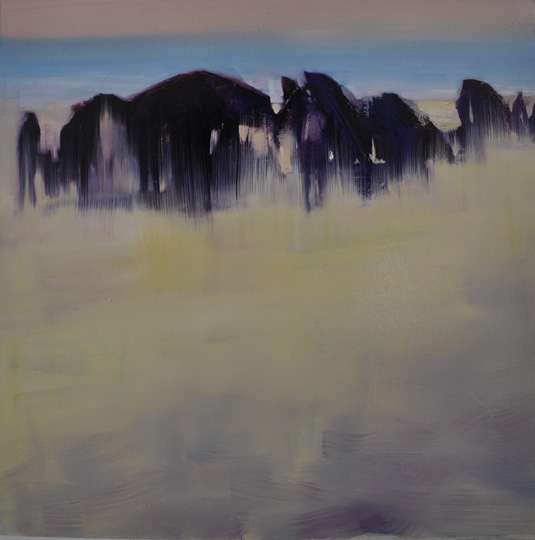
example 11.step one.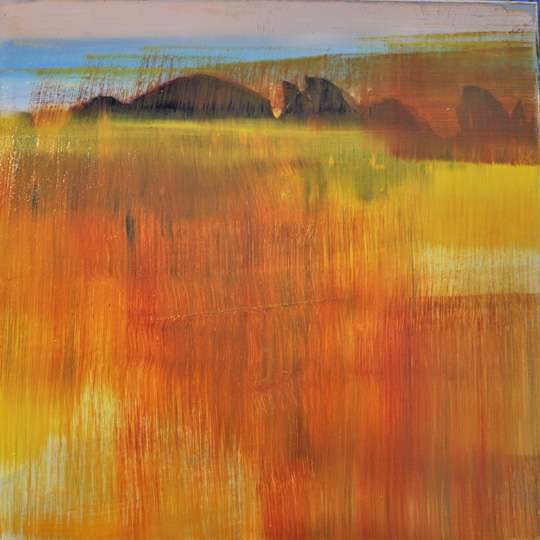
example 12. step two.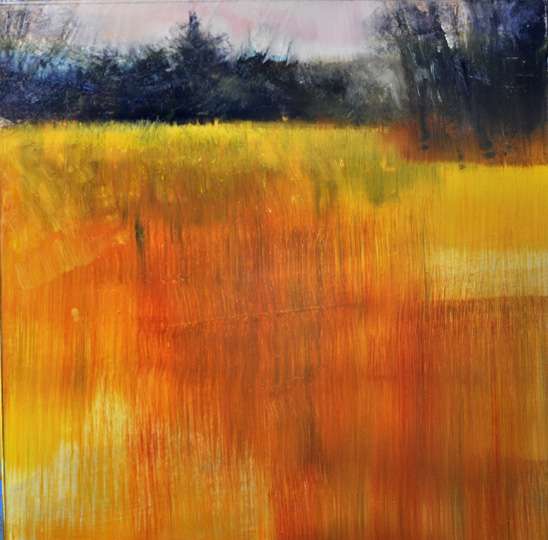
example 13. step three.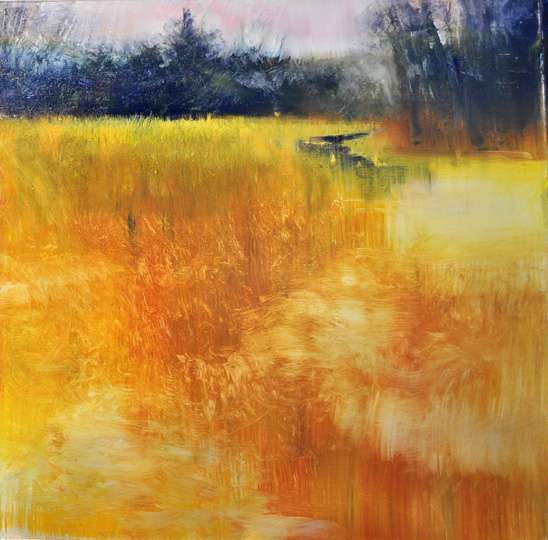
example 14. last step to date.
Fredric Neuwirth
Too much snow Will get to it this afternoon
Fredric Neuwirth
The small studies are more relaxed as there is no pressure to do a GREAT work. The result does not matter as there is less effort extended. Once the painting starts to get bigger it takes on an investment of time and effort. It would be great to free one self up from that and view all your work as just studies no matter what the size. It is worthy goal. The great value of the smaller studies is that it should free you up to be more spontaneous on a larger work as you have done the 9 previous studies. But unfortunately it does not always work.
Examples #10 -14. It is great to have previous work that can be re-created. The serpentine of the water and the grasses is very effective.
Margaret Hunt
More than one ah ha moment reading your posts today. Thanks so much for your sharing. LOVE your new pbs series…spreading the word about that to all my artsy friends. EXCELLENT work!
Kay Halcrow
These paintings: great! No. 7 really ! Very useful thoughts, reminers…