
Magicians rely on our inescapable and automatic response to track a motion, to anticipate the direction of that motion and to separate the tracking subject/object from the background. If the magician provides a convincing motion we will follow with eye-tracking and, believe we are seeing reality not fiction because of our subliminal sense of anticipation. Can this perceptual phenomenon also be exploited by artists? I think so. If we work through texture gradients fitted into a perspective map we discover a strategy to distract, puzzle and sustain the viewer’s attention as they try to find their way through the labyrinth’s directional clues.
The following painting examples are constructed to give a sense of coherent complexity like a densely detailed map. When reading a page or a map we employ our sense of anticipation which results in our scanning and not focusing on every possible focus point. Most of our field of vision receives zero to little attention. We follow trajectories, paths, and the directions of a motion while we pull objects out of the background to track their motion. Motion direction and figure/ground selection allow us to comfortably navigate complexly textured territories. We suppress background information until it startles us (for example, with a noise or sharp edge of contrast).
In example 1. I present a 40×60” aerial painting of Manhattan. We don’t initially notice that the building information is constructed entirely out of loose squeegee marks. The variety of marks and contrast levels appear consonant with experience if we do not look closely. In example 2 a similar experience is offered with a different profile view of Manhattan.
Example 1, Manhattan Aerial, oil on anodized aluminum.

Example 2, Manhattan Profile, oil on anodized aluminum.

The next images present organized complexity packed with arching lines of directed motion. While there is not the deep linear perspective space of the aerial view paintings instead, there is a matrix of overlapping forms which suggests space to the viewer. To demonstrate how this effect was built I present three continuous steps toward the latest step which also uses complementary and simultaneous color contrast to create a sense of vibrating space.
Example 3. Step one, Wildflower Matrix.
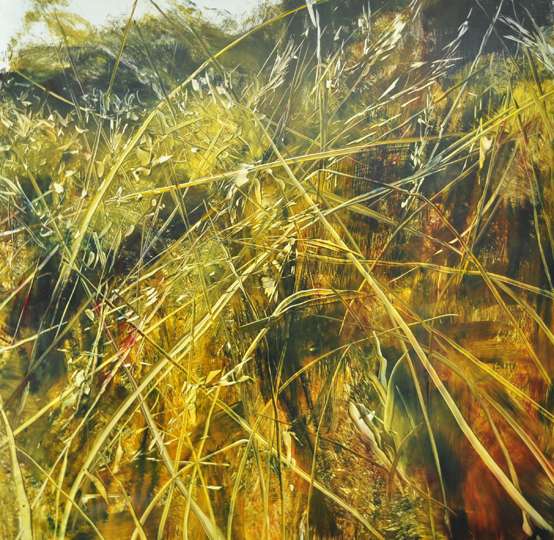
Example 4. Step two, Wildflower Matrix.
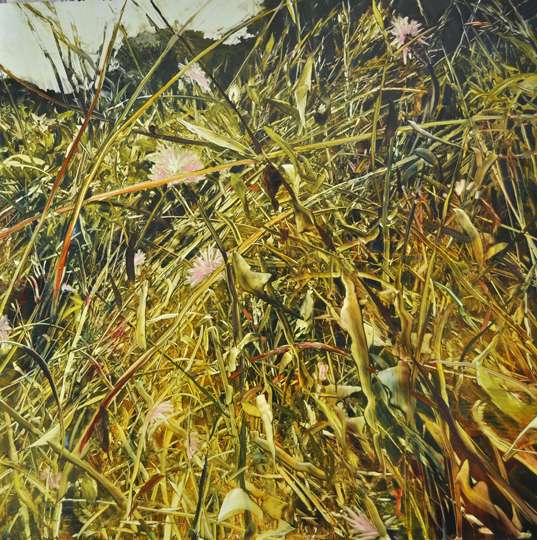
Example 5. Step three, Wildflower Matrix.

A similar process was used to build the image in Example 6. Example 7 merges the aerial views’ linear perspective and atmospheric perspective system as demonstrated in the first two examples with a more intimate viewing distance presented in the Examples 5 and 6.
Example 6. Overlapping shapes with complementary color.
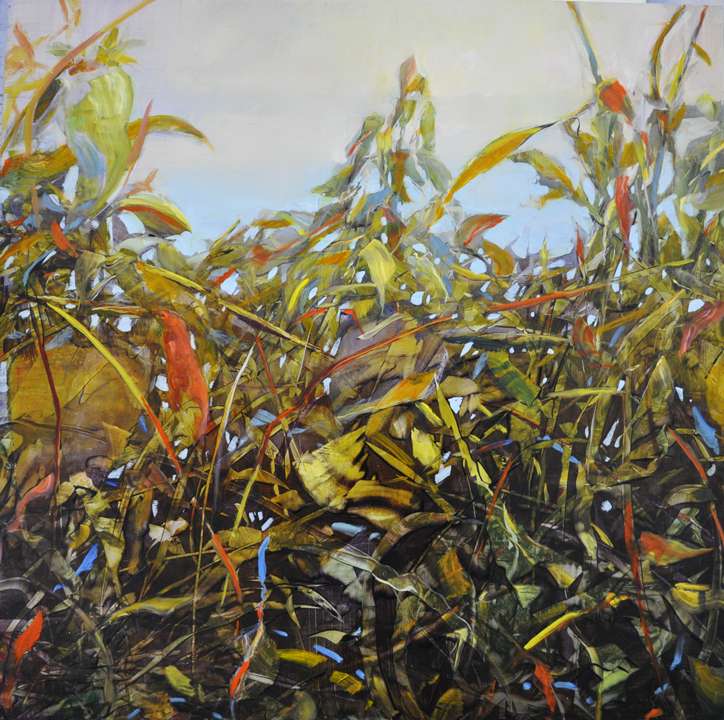
Example 7. Aerial mapping and atmospheric perspective merged with complex intimate space.

Dave Mazza
Great discussion of how limited information can draw the viewer eyes (and mind) through what would seem a somewhat ambiguous image. Seeing the process of your examples in a video would be great.
Luz
Excellent post! Thanks!