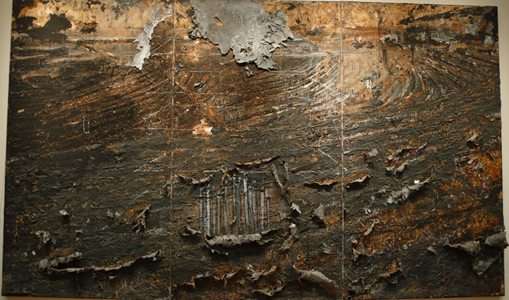
With the development of linear perspective artists became more aware of the compositional possibilities to be found in the principle of the relative diminishing size of objects toward infinity. They observed that all things big and small, diminished in proportion to their distance, to their proximity to a sight line. In the case of my examples the sight line is coincident with the horizon line. As areas and objects approached the top of the picture ( top of the picture plane) or the bottom of the picture ( bottom of the picture plane) the areas and objects appeared to not only get bigger but, to appear closer as well. They noticed that the areas that were closest had crisper edges, more variegated texture, and stronger contrasts. They also noticed that if you raised the horizon line the amount of territory not only increased but, the distant extent seemed to increase as well. Conversely, you could expand the feeling of distance by lowering the horizon line and increase the sky area. Increasing sky area gave the same space expanding effect as increasing the foreground area. Either way, If you exaggerate the area of sky or the area of foreground you will push the horizon back . By marking out equal size territories for the sky and foreground the picture tends to flatten and divide. My first example shows a Jan Van Goyen landscape from the 1600s. The horizon is low and consequently the sky is large. The clouds are larger at the top than along the horizon. They are also darker at the top just as the foreground is darker at the bottom and becomes lighter toward the horizon. Both sky and foreground appear to get lighter as they recede to the horizon.( The ratio of difference between light and dark diminishes with distance).  If you were to turn this painting over you would discover the proportional difference is similar, just reversed , sky to foreground. In the other two examples, the first is an oil on copper by the artist( my son) Max Dunlop and me. As you look out the smeared train window you see lines converge to a single vanishing point on the sight line. As you observe the Anselm Kiefer painting with its masted ship you can observe that he too uses recessional lines of perspective to increase the sense of space ( see the radiating black lines in the diagrammed examples). In both these examples the horizon has been lifted to supply a greater sense of foreground and enormous depth. By placing the sight line either very high or very low the artist can increase the feeling of space. You can increase the feeling of space by using a gradually diminishing texture toward the sight line. The high relief textures in the Kiefer are placed low in the picture plane, close to you. In Max and my train window we spread a gooey but, immanent texture across the entire picture place because the picture plance is covered by an illusory window. All three examples use the same red-brown iron oxide based color whose grays are achieved by mixing white and blue with the re-brown pigment.



Connie Simmons
How fascinating! What great – and unusual paintings to relate together! I always learn something when I read your posts, David.