
If vision is interpretive rather than absolute then any tool that can suggest an interpretation, no matter how vague, how blurred, or how ambiguous will be a persuasive tool. Fingers have been a fundamental part of our tool set since we made our first image on a cave’s wall. Fingers leave their trace, the evidence of fingers in the paint. We have always relished a free and expressive gesture and, no tool is more immediately and finely tuned than our fingers for making nuanced gestures.
Fingers can of course guide and inhabit all kinds of extensions such as rags, brushes, knives. They can tickle a trail in paint with a single hair as subtly as water-spider skating on a pond. What follows are illustrations of how we employ fingers directly and with some technical extensions. Here are illustrations of how we use are fingers to conjure an interpretation (an image) while sustaining and not hiding the evidence of the fingers at work.
We can’t interpret without previous experience, without a mental preset. In art that experience comes from our own encounters with art history. They guide us as we make new art whether we realize this or not. There is more freedom and creativity if we do realize the sources of our experience which guide our visual interpretations, our interpretations of everything we encounter. Here are a couple of examples. Example 1 presents an Andrew Wyeth egg tempera painting of conifers reflected in a pool with an undulating shoreline. As I scouted painting locations in the White Mountains of New Hampshire this weekend I snapped this image ( example 2 ). I realized I had discovered a visual idea (the Wyeth) I knew before but, was now reconfigured in my new view. I further recognized another image lay dormant in my photo, a painting by Gustav Klimt (example 3). You can see how these were sources for my photograph.
example 1. Andrew Wyeth, egg tempera. 
example 2. my photo.
example 3. Gustave Klimt, 1899.
Wandering along clear White Mountain streams I found other influences for my camera and later paintings. Along a rocky stream I was reminded of other paintings which awakened my imagination, my desire to re-interpret. Example 4 shows a stream painting from 1810 by Simon Denis. My step by step examples will take you through my experience of re-interpretation as stimulated by my encounter with a mountain stream. Example 5 presents step one as I lay in ultramarine blue on brushed gold anodized aluminum. Even in this vague and blurred image I see I can interpret the sensation of stream with a dark forest alongside. Example 6 presents step two. Here I use Gamboge yellow for a warm and shallow foreground. I blend it into the ultramarine blue in the back. Example 7 reveals my use of finger painting with paper towels. Example 8 demonstrates a scene which is less accessible to multiple-interpretive viewing. There is less ambiguity. I now think examples 6 and 7 were more evocative, more capable of varied and sustained interpretations.
example 4. painting by Simon Denis,1810.
example 5. Step one, the lay-in.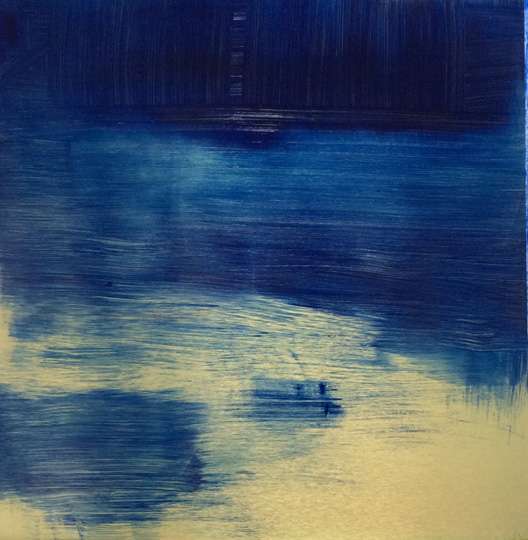
example 6. step two, introducing yellow.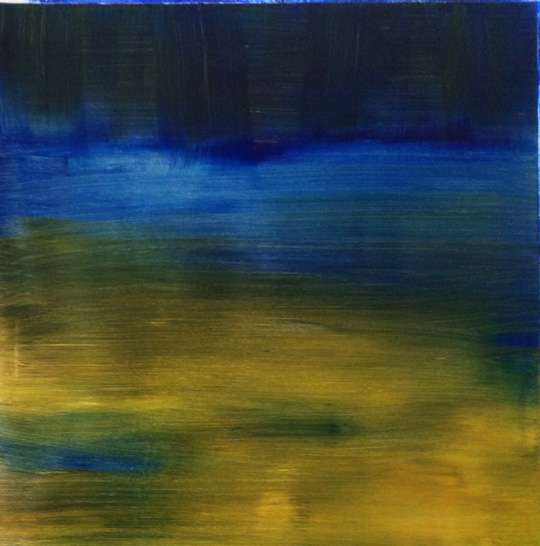
example 7. step three, initial finger and towel work.
example 8. step four, blurred opaque paint with brushwork.
Let me further demonstrate the suggestive power of finger painting. Here in two steps ( examples 9 and 10) I want to illustrate the gestural pleasure and the suggestive potency of loose finger painting. Example 10’s trees and foliage were almost completely painted with bare fingers and, with a paper towel wrapped around fingers. The range of variety in the marks is broad because, our fingertip touch offers great variety. We exhibit more dexterity and variety with our fingers because, our experience with them is the greatest of all the tools at our disposal.
example 9. The trees lay-in with yellow and azure blue.
example 10. After the finger painting.
Elaine finsilver
Loved loved the blog. As usual, colors great. We can always buy gamboge and ultra marine but where can you buy Dunlop fingers?
Gail Ingis
Clever lady, that Elaine. I ask the same, where can we buy Dunlop fingers? The one art that baffled me as a kindergartner, was the finger painting. I disliked it and didn’t know what to do, but I have made up for it. I love using my fingers, they are my favorite tools, and not only for painting. I enjoyed this blog. Your blog are always awakening. thanks David.
Riitta
I feel much easier to breath after reading this. Thank You!
Pat Sawyer
As always, marvelously thought provoking with skilled and creative illustrations. And now I look forward to tackling rocks and using the shadowy, sunlight pathways and swampy, tree laden photos I’ve taken. Such gorgeous colors and rocks!
Pat Sawyer
That is, “sunlit”
Fredric Neuwirth
Simon Denis was a very good Flemish painter. His cloud studies rivals Constable.
I agree w/ you Examples #6 & 7 are best and leave more to the imagination.
Your fingers work if you know how to draw but learning and seeing may take a life time.
Linda Botwinick
I always use my fingers,they are always there and I do not have to locate the proper tool. where can I get the gold anodized aluminum?
David Dunlop
Linda,
Glad to learn of other finger painters. If you live in New England try Hart Supply in Hingham, Massachusetts. If not, try Laminators Inc. in New Jersey.
Best, David
Marianne Lenti
I wondered about the role of the metal support in your amazing detail work with towel and digits. Have seen you work in this manner on your wonderful series, which seems to feature a glazed paper of some sort. Can this work on cotton duck canvas? Love the atmosphere you create over the water.
Larry Harris
Mr. Dunplop,
Thanks for sharing your insights into stream interpretations.
I am a novice painter and find the use of fingers a s natural in the process as eating with them on occasion.
I particularly like the slick water shown in the foreground of example 7.
As a long time avid fly fisher, the slick water demonstrated is extremely enticing to me me because in front of that large rock is very often the home of a large Trout. Merci.
William Child
Great blog! Beautifully written and interesting. We many times might perceive our beings as separate from other natural phenomena. We are very misled if we strongly contemplate such ideas. The river of life flows through us at many levels and is better understood when we observe and connect with the forces that stir all the world!