
We enjoy seeing complex patterns transform. Our brains evolved to take interest and pleasure in this process whether we find it in paintings or music or math or architecture. For example, by 1614 Dutch artists like Jacob Pynas (example 1) built their pictures with such obvious rhyming patterns that they seem heavy handed by current standards. Let’s return to Pynas’s studio and see how he applied rhyming shapes in sequences that helped build deep space in his landscapes. Observe how his picture staggers rhyming shapes in receding regular intervals. Example two’s diagram outlining should help you locate repeating shapes whether they were clouds or trees. The repeating gumdrop tree clusters were packed rhyming groups along the edges of the rhyming curved hillsides.
Example 1. Jacob Pynas landscape, 1614.

Example 2. Jacob Pynas landscape diagrammed.

See how the sequence of tidal pools creates another interlinking chain of rhymes. They diminish in scale and increase in brightness in this painting which I have recently revised adding more luminosity and atmospheric perspective (example 3). I took this same design and stretched it horizontally to find more counterpoint directional opportunities within the image (example 4).
Example 3. Barn Island painting with added luminance and atmosphere.

Example 4. Barn Island painting reconstructed as a horizontal with more bravura brushwork.

If you were to take Pynas’ painting seen in example 1 and reverse it as if seen in a mirror you would discover similar design motifs to my painting in example 6. Pynas’ framing, curving dark trees were substituted with talk curving leaves or fronds and, his repetitive curving hillsides were replaced with the stacked crossing curves of long leaves. Even my central pond sits under a curved form echoing gently repeating arched leaf shapes. Notice how the painting appeared without its later blue tones and atmospheric overlay in example 5.
Example 5. Step one, my painting with Pynas design reversals.
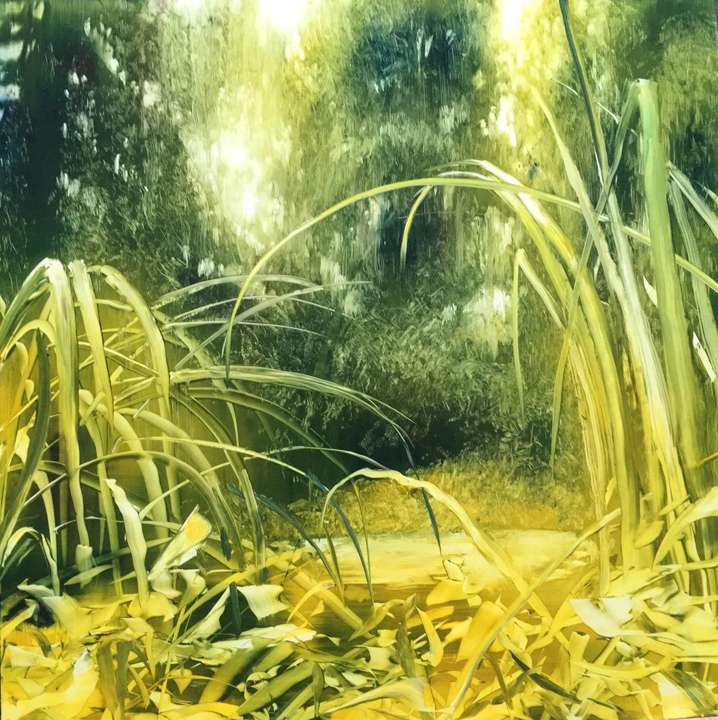
Example 6. Step two, my painting after adding atmosphere and darkening interstitial spaces.

Sequenced rhyming shapes can create space using rectilinear shapes as well as biomorphic shapes. In example 7 observe how Lucas Cranach in 1545 (almost century before Pynas’ painting) uses the trapezoid shape of a pool to extend space. Here the subject is intentionally risqué. Older women willingly enter a pool which gives them back their youthful form. As they emerge from the pool they join noblemen at banquet and couple-up for libidinous activity in bushes and tents.
Example 7. Lucas Cranach, Pool of Youth, 1545.

Like Cranach I used the trapezoid shape to direct you into deep space as you see in example 9. Example 8 represents my first step, laying in the basic structures with their reliance on flawed rhyming shapes extending into the distance. In example 9, step two, notice the added atmosphere, the added layering of more geometric shapes and color. The foreground received a deepening shadow color of translucent phthalo cyan as well as a series of rhyming geometric shapes running in counterpoint to the shapes beneath them.
Example 8. Step one, “West Side Stories, Multivalence” blocking in the structure.

Example 9. Step two, after adding glazing, atmosphere, and overlapping patterns.

Esther Sodani
I always look forward to your posts. I am in the learning fade of painting and your blog helps me review and expand what I have learned but also helps me see and understand different techniques.
Thank you for sharing.
Esther Sodani
Maria D Sortino
A mi también me ayuda su blog, gracias David Dunlop´s!
Luz Montoya
Your piece in steps 5 and 6 really shows the concept. I’ve learn a lot from you. Thanks a lot!
Roger Brown
Thanks for a fine post David. I’d not seen the Cranach and love the pictorial suggestions!…elderly ladies being brought to the pool of transfiguration in wheelbarrows, piggyback, litters and horse drawn carts…call up the reserves!
My Best,
Roger
Vivian Haberfeld
I’m so excited to be joining you again for the Fall Semester. You inspire me so! 🙂