The success of ornament lies in viewing it from variable distances so that the dominant design lines give way to details as we approach. That is how Ernst Gombrich summed up the experience and success of ornament. Paintings can work similarly. As we step back from a painting it improves coherence and offers a heightened sense of illusion. We are less aware of the material nature of the paint and the traces of brush marks because, those details dissolve in a field of diminishing complication, diminishing acuity, when we step back . We aggregate details into a united image. This is how we experience the world. We guess about its identity through extrapolation from the bits of information that have been more closely examined, those bits which we have brought into focus. In painting as in ornament, there is a dual pleasure. First, there is the pleasure of discovering a designed instant unity; the pleasure of recognition from a distance. As we step back we manufacture unity and coherence when viewing a painting. From a distance we are more visually able to see its entirety. Secondly, as we approach the painting or ornament we begin our second round of inspection. In a painting, we can now enjoy the evidence of the paint and the marks that were generating their magic just a few steps back. This is the art work’s second reality. Sometimes we are disappointed by our close inspection if it uncovers slovenly or awkwardly or self-consciously or timidly executed work. We may notice the weakness of a tedious repetition of marks or patterns which were unnoticed when we viewed the work from a distance. I find pleasure in generating these two identities for the same painting, the distant viewpoint and the close viewpoint. I aim to have both experiences succeed, to sustain the viewer’s attention. I also pursue two different identities for a painting with my palette and the light. As the ambient lighting shifts from photopic( diurnal) viewing to scoptopic( subdued light) viewing our color reception is altered, and therefore; we receive altered impressions of the painting. I will save this topic for later discussion. 
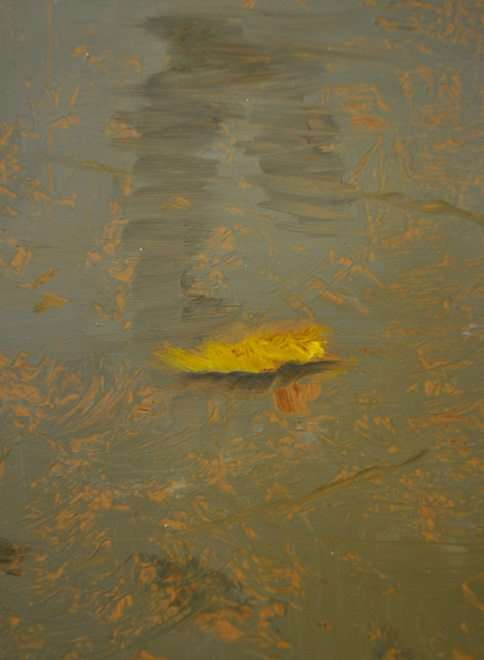
 In my examples I have painted on two different metal surfaces. In the first example, I painted on 23 karat gold leaf which I adhered to aluminum. The entire painted surface has first been gold leafed. Painting on this fragile surface allows me to reveal a wide variety of marks with subtle differences. I used soft brushes , loose or oily paint, and delicate touches. As you approach the work ( see detail example, 2nd image) the minute marks become obvious in their variety. In my second painting example, I have painted on copper. The copper can withstand rougher treatment although, I am still gentle to achieve a broad range of marks. Again, I subtly delete and move paint about the surface to reveal the tone of the copper in delicate patterns. In the detail example you can observe the traces of copper as they are unveiled beneath the translucent glaze of oil tints.

Leave a Reply