


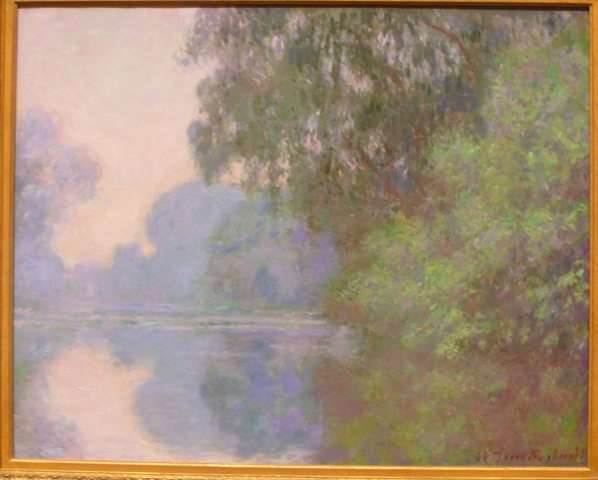
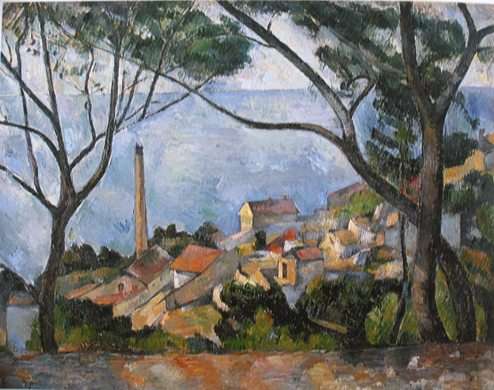
 In the 17th century in Italy were many great landscape painters, Domenichino, Carracci, Dughet and the two most influential, Nicolas Poussin and Claude Lorrain. They all operated with a formula of composition that descended through the theater from ancient Rome to 17th century Italy. Imagine a stage set with a curtain draping along one side; it drapes in an angle forming a soft triangle. Our window drapes and curtains behave the same way today. It’s the same tradition. This curtain frames the stageset, the scenery. In the distance the light goes soft and the edges dissolve. As you move from the foreground into the distance you encounter an architectural subject in the middle ground . You continue to wend your way back in a rhthmic meandering pattern toward infinity. This form was admired and used by every landscape painter from 1600 until 1900, from Europe to America. I have spoken of it before and, shown you how Sanford Gifford used the form. Now, I want to show you how prevalent it was and how the form evolved. The large dark framing curtain/wing was called a coulisse. It had a counterpoint shape on the opposite side of the picture. Here is a chronological sequence of artists all borrowing the same form. I have reversed some of the images so that you can see their analogous compositions. Claude and Poussin did not originate the form. They perfected it. My examples start with Claude. In his version there are little mythological figures, Narcissus plays out his story. Next, I bring you quickly to the 19th century. I could have shown you many 18th century versions of the form from Watteau, Fragonard, Wilson and others but let’s hurry along. Next there is Turner imitating Claude and then, Constable. He’s a little grittier and is changing the form mildly and, adding more color. Then I show you a Corot. Corot softens the form in the foreground as well as the back. It’s dreamy and influential to the next example, Monet. Monet is using an analogous harmony and again, very soft edges. Finally, Cezanne uses the same form even though the trees are spindly. Here Cezanne shows you a flat surface of paint and, an illusion. It flips between those realities. The sea presses up against the front of the picture plane. The brush strokes remind us that this is just paint on a flat surface. I think Constable may have given him that idea. And, in Cezanne’s picture we have the beginnings of Cubism. Look at the buildings. See how he is flattening them, contorting them.

Leave a Reply