
Early in the 1800s artists, writers, musicians responded to a new theme, Romanticism. Here was an opportunity for exaggeration filtered through a personal point of view. Here was a chance to be theatrical using the idea of one perceiving mind, vulnerable and alone before awesome nature. The question for these artists was how to contrast the power and expanse of nature against the solitary artist. Early in the century Caspar David Friedrich determined to show this Romantic idea in paintings that today feel like backdrops for melodramatic stage sets. But, he also discovered the beauty of solitude as an inspired condition when set in a vast nature natural setting.
Friedrich maintained the conventions of the historical landscape form especially, as he found it in Dutch landscape Painters of the 1600s. He amplified the experience. This would be the course for Romanticism for the next century through expressionism.
Friedrich appears too literal when compared to our contemporary preference for understatement, irony and cynicism. But his romantic spirit survives. It survives most obviously in our pop culture’s movies and music. It also survives more subtly in our paintings. Example 1 is Friedrich’s 1832 landscape. Note the solitary, small boat tucked at the rear the river’s meanderings. The palette is not jubilant. The marks are carefully and soberly plotted but, the feeling of space is vast and liberating. Example 2 is another of Friedrich’s. Here is a solitary monk below an immense sky. The year is 1809. If we leapfrog ahead 100 years we see the contemporary painter Gayle Stott Lowry’s handsome work which resides in the North Carolina Museum of Art ( example 3). I think her inspiration came from a visit to Ireland’s Ring of Kerry. I recently found the same Romantic landscape there. And, I found that Friedrich’s landscape forms as well as his themes were useful to organize this setting.( photo in examples 4 and 5).
example 1. Caspar David Friedrich 1832
example 2. Friedrich 1809,
example 3. Gayle Stott Lowry 2006
example 4. Ring of Kerry photo 1
example 5. Ring of Kerry photo 2
This Romantic Irish location at the edge of Europe urged me to make my reply to Friedrich and Lowry. The painting was based from the photo in example 4, as you can see. The composition has been used by many including Friedrich and Lowry with the left and right wings of the painting gently inclining asymmetrically toward the center. I exaggerated the distance by applying a diffused opacity over the distant area and, applying more specificity to the edges of information in the foreground. The foreground also is darkened with higher contrasts than the distance. Example 6 represents my first step in the painting. Example 9 represents the painting as it now appears, a work on 3mm anodized aluminum, 24×24.
The compositions as well as the Romanticism of Friedrich’s landscapes reach subliminally across time and geography. Example 10 is a work by artist Janine Robertson who painted with me recently in the White Mountains of New Hampshire.
example 6. step one
example 7. step two
example 8. painting from White Mountains by Janine Robertson, a 5 x7″ work on copper.
Romanticism spread its influence across the 19th century and across the continents. The idea of the enchanted forest which descended from ancient Druidic and Celtic cultures enjoyed a revival in Romantic 19th century landscapes from the Hudson River painters to the Barbizon tonalists. George Inness used theatrical romantic ideas in his paintings. Here again was a solitary figure at the edge of a dark woodland but, hope is sustained by the reflected sunlight in both the background and highlighted tree trunks ( example11). The composition is Claudian but, Inness has begun to distill the image into an atmosphere, a poetic and melancholy atmosphere of contrasted darks and lights .
In the 20th century I can revisit the “Into the Woods” experience with my work (example 12) which sustains Inness’s effort at evocation of enchanted nature through distillation and simplification. There is just shadow in the darkness. We supply the idea of details. Example 13 is the photo I used to begin my painting. Example 14 was a pre-existing painting which I painted over to make the painting you see in example 12. Notice how I incorporated aspects of the earlier painting and aspects of the photo into the new work.
example 11. George Inness painting
example 12. “Into the Woods”, current version of my painting
example 13. Original photograph
example 14. Original painting which was over-painted
By the 1890’s artists like George Inness were dramatically reducing the quantity of narrative and detail in their work. This distillation process would prove to be a method of modernism and abstraction in the coming 20th century. Earlier Corot had tried simplification in the mid 1800’s. Corot’s ideas and compositions would be borrowed and modified by others like Inness, just as Corot had done. Example 15 shows a landscape of Corot’s with a copse of trees on the right and a shallow body of water in the foreground. Example 16 shows how Inness aggregates the trees into a single mass on the right, removes the litter and the boat, and returns the water to the foreground. The entire image is deliberately obscured to heighten our feeling of atmosphere, unity, and luminosity.
example 15. Corot’s boat, pond and meadow
example 16. Inness’ pond & meadow painting.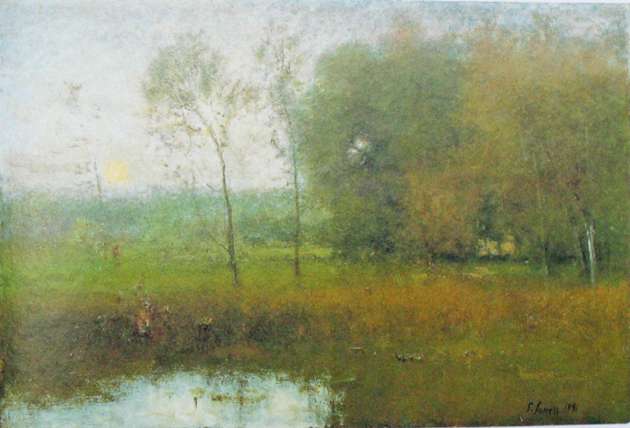
While Inness had pursued simplification through an ambiguous atmosphere others like John H. Twachtman would do the same but, they would also try simplification through palette and design. This idea had come to Europe through Japanese woodblock artists like Hokusai and Hiroshige. While in France and testing the new ideas of pictorial simplification Twachtman also tried the simplified shapes of the Japanese artists. A result of this work can be seen in example 17. Artists like me would later (a century later) find inspiration in Twachtman’s synthesis of Japanese and Romantic Impressionist ideas. I enjoyed his harmony of a simpler softer palette. I enjoyed the simplification of background information into a luminous amalgamated mass. And, I enjoyed discovering sharp edges hovering before that softer background. In fact, they set off the blurred background. In examples 18 and 19 I borrow the Romantic ideas of deep and unpopulated space as well as the subject and brush vocabulary of Twachtman.
example 17. Painting by John Twachtman, 
example 18. painting by me,24×24
example 19. painting by me, 24×24
Dave Gehman
Wow.
Amazing post. Fascinating to watch the flow of attitude and expression across two centuries and more – and no small feat on your part to capture all of this and reduce it to the essence.
Ron Raasch
David,
Following your footsteps (blogs and DVD’s)
is a continuing learning process. Thank you for your dedication to history and your ability to share.
Ron Raasch
Fredric Neuwirth
#1- Is Gayle Stott Lowry both a painter and a photographer? Is #3 a painting or a photograph?
#2- Where is example #9 ?
Wasn’t Twachtman part of the “tonalist” group. It is great painting.
#18 & #19 really capture the feel.
Great blog!
Elaine finsilver
The paintings bring tears to my eye. I find them very peaceful