
Sgraffito, “to scratch (in Italian)” is ancient process. Since antiquity artists have scratched through surfaces to reveal substrate colors. In Ceramics an artist scratches through layers of surface glaze to reveal other colors below. Artists from Da Vinci to Cezanne have scratched and incised their wet paintings to exploit the effects of underlying color. Today’s sgraffito tools include more than a palette knife or the end of a brush. Printmakers (etchers) use drills, chains, burins, scrapers and any device which leaves a unique trail in the surface metal, i.e. the plate upon which the image is made.
The autographic evidence of scratch marks serve as both a method and inspirational source spans across time from Rembrandt to Turner to Cy Twombly. Example 1 presents a work of Cy Twombly’s from 1960. His treatment of surfaces relied upon the effects of his scratch-writing technique. Twombly’s use of erasures is another form of sgraffito applied here.
Example 1. Cy Twombly.

Now imagine the pleasure of scratching through a polished and blended surface with substrates of various colors and textures. James Whistler, an etcher as well as painter, recognized that drawing and painting could be enhanced by scraping and scratching. He worked in thin layers of paint which he then wiped, scraped and scratched as seen in example 2 (Whistler painting of St Marks, Venice).
Example 2. Whistler painting.

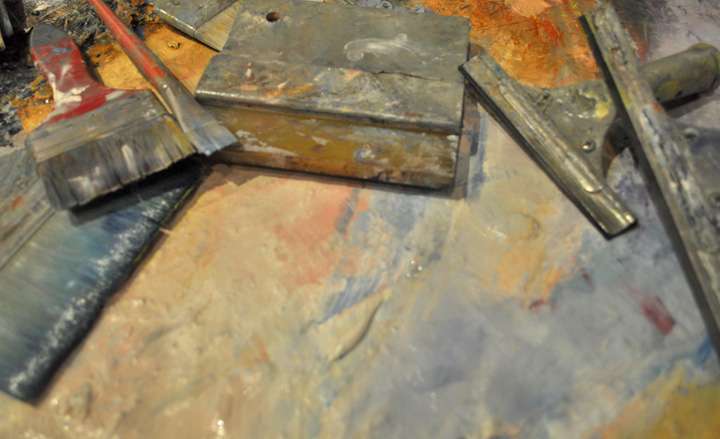
The next examples first show an initial underlying image with varieties of color and texture followed by overlaying colors which then receive sgraffito treatments. For the initial painting and blending of color I use soft flat brushes from 1” to 8” wide. For the sgraffito tools I have a broad selection of squeegees and a silk screen hard plastic scraper bars. Example 3 provides a photo of a few of the brushes and sgraffito tools.
Example 3. Brushes, scraper and squeegees.
Starting with a manipulated photo of a marshland (example 4, step one), I begin a journey of distillation and reconfiguration. Example 5, step two, represents my initial image which evolved into example 6, step three. The lower 3/4ths of this image (example 6) gets covered with veils of blended oil color. While wet I apply the sgraffito marks you see in example 7.
Example 4. Altered photo.
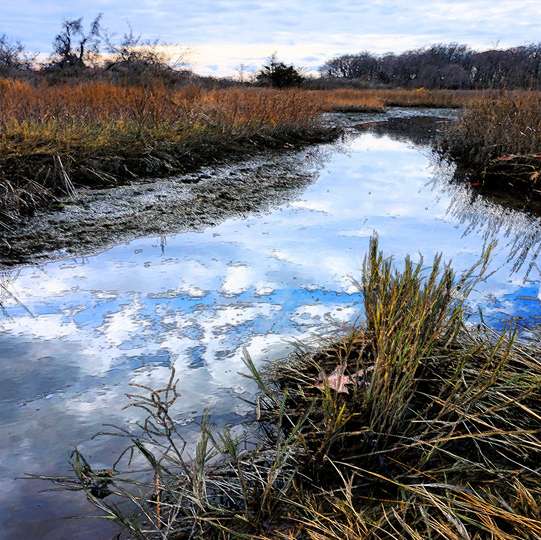
Example 5.Step one.
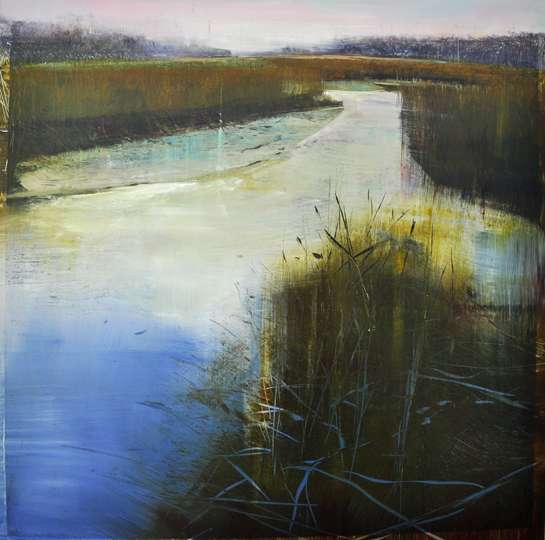
Example 6. Step two.

Example 7. Step three.

I employ a similar process with examples 8(step one) and 9(step two). Example 8 has the applications of color and texture which serve as the substrate for the later application of blended color and subsequent sgraffito marks in example 9.
Example 8. Step one, underlayment.
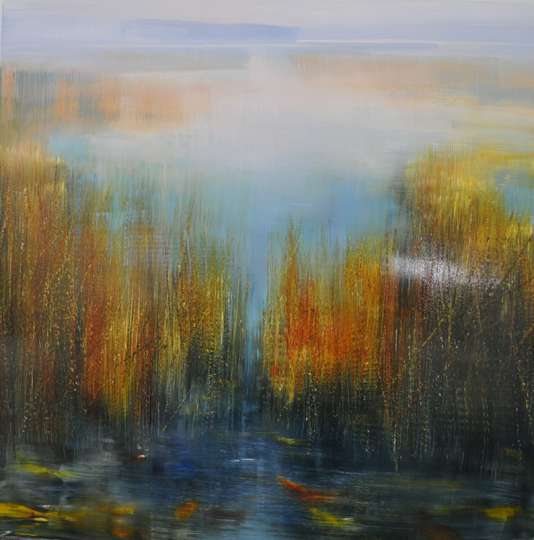
Example 9. Step two, after blended overlays and sgraffito.

Of course the process need not conclude with the sgraffito. Examples 10 and 11 trace a process which moved through the initial lay-in, followed by sgraffito squeegee work, followed by finger sgraffito work, followed by additional paint and bristle sgraffito effects. In the final application of paint the small thin bristles scratch patterns into the water area to suggest vibration and subtle motion.
Example 10. Step one.

Example 11. Step two.

Rhonda Walker
Loved this demo! Beautiful examples of the transition from representational painting to explosive light filled atmosphere. Thank you, this brightened up this snowy,grey day!
Gail Ingis
Really David? LOL. Sitting and enjoying palm trees, and scatched, hardly discernible, paintings . . . you are amazing. Thank you! Carry on . . .
Nancy Hilden
Been doing this process by painting over old paintings of mine, particularly light over dark. Mountain series for Berryessa National Monument