
For more than 50,000 years we have been painting what we know, making clear, legible iconic images that represent our ideas about life. We still do it. 2,600 years ago the Greeks took new look at representing images and tried to make them as they appear to us or, what we see. We ended up with pictures as seen from a particular or single point of view. They were still legible because we( the Greeks and us) merged the idea of depicting what we see with what we know. Outlining objects or figures is a form of this. We don’t see outlines around objects but, in order to clearly identify or categorize them we outline them. You can see this in the Renaissance painting of Pintoricchio (example 1) or even Michelangelo.
example 1.  ( Pintoricchio)
example 2.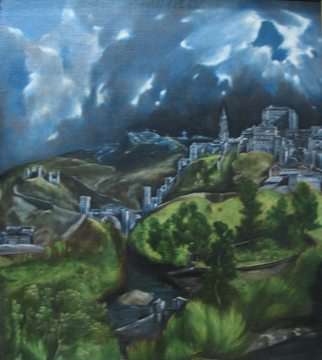 (El Greco)
But, about the time of the Renaissance a few artists started to think differently about how we see and how we feel about what we see. Da Vinci considered how we see with blurred edges, and how we guess about the identity of something by looking into an ambiguous visual territory. He realized that less classification (outlining) allowed for more ambiguity and a greater sense of reality because, it more closely resembled how we see. El Greco’s paintings took a different direction again. His paintings appear to be about how we feel about the subject (example 2). Their distorted forms evoke feelings. By end of the 19th century Vienna was host to the idea of paintings performing the role of a conveyor of feelings, forbidden or repressed sexual feelings as in the work of Egon Schiele or, later in Germany with Otto Dix or Max Beckmann the paintings could convey political feelings, or personal feelings in myriad of directions. Meanwhile the concern for how we see was never abandoned as well. Cezanne pursued paintings which reflected how we see, planes of reflected light off a basic set of shapes ( shapes once described by Socrates as the fundamental shapes, cone, sphere, cube) inside of a traditional design format. Throughout the 20th and into the 21st century artists continue to pursue understanding how we see and how we feel(emotions). In a collaborative venture with a fellow artist, Kerry Brock, I tried to use both of these motives in my response to her work. (example 3. initial work by Kerry Brock).
example 3.
By the way, I gave her a work of mine with which she could do whatever she wished just as I had with her painting. It’s part of a project for artists associated with the Silvermine Guild of Artists. I considered that Ms. Brock had given me a work with a deliberately flat design and deliberately without illusory space just, the grid of color and pattern on the flat 36×36 square of masonite. I thought first about using her palette ( I liked the complementary color effects) and her idea of a grid but, I would impose an illusory space with a strong sense of infinity. I used Renaissance principles of linear perspective to achieve this. I knew that Ms. Brock was from out West, Eastern Washington State and, that she had a predilection for big spaces. I was simply laying her grid pattern down so that it could be seen from an elevated foreshortened perspective with landscape references. How we see and experience deep space in motion became my interest. Ms. Brock’s purpose had be to design a bright, flat space. You can see how I changed her work step-by-step in examples 4, 5, and 6. How to make that space move by canting it and blurring the distance were additional ideas as you see in the final example. Everything progressively fades in the distance, colors, contrast and edges. It’s of how we see.
example 4.
example 5.
example 6.
Carole Buschmann
Wow!! I love it and it makes sense to me . beautiful, aesthetic sense. You’ve opened my ideas/response /thought with this.
Fredric Neuwirth
I wonder what Ms. Brock’s response is to your imposed linear perspective on her rigid grid? I am also curious to see what she has imposed on your space. Sounds like fun!
Iam reading ( at your recommendation ) “Imagine ” by Jonah Lehrer. Painting by the right side of your brain? It seems to me that you have this ability when you sit down and look at what we have painted and are able to contribute that intangible insight!
Fredric Neuwirth
It is actually 2:34 AM not 6:34 AM
Gladys Freyer
Your piece is so much more vibrant and exciting. It reminds of the beautiful view from a plane window.
Alice Jackson
I’m guessing that you give each other paintings that you are not satisfied with. Can we see what she did with your painting? The more demonstrations you show us, the better my brain is able to process and understand the blurring effects. Thanks for showing us the steps along the way.
Kay H.
Loved that 4,5,6! Reminds me in a kind of way of the transition from Appolonius’ Conic Sections where the sections are laboriously but rationally analysed to those of Pascal, where he moved the viewpoint to the top of the cone and dropped a plane through the cone, which as it drops, cuts through the cone in the various conic sections.
Kay H.
Also, regarding outlining, do we not see/seek edges to help us comprehend what we are seeing? Is there a difference between an outline and an edge?
Kay H.
Liked your discussion of incongruities on your new Painting Skies DVD which answered this question I had.
Kay H.
In these and previous postings you have shown images that have evolved sometimes by layering. There was an article in Science News today (“Stone age art gets animated”) : “Ancient artists at France’s Chauvet Cave superimposed drawings of two bison to create an eight-legged beast intended to depict trotting or running, two researchers say.”
Keith Brooks
Thank you for doing this, David!