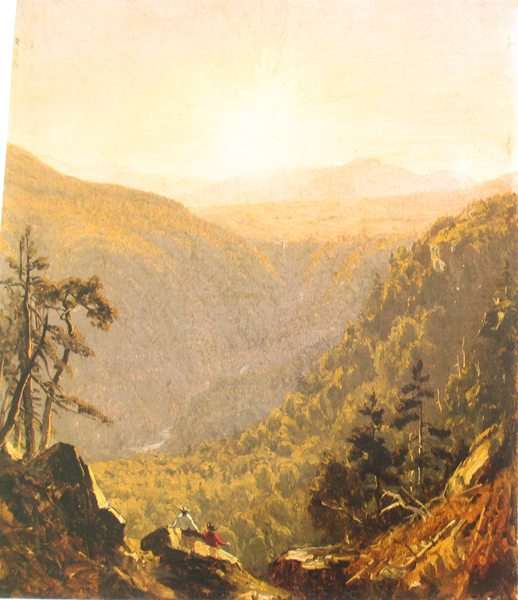
 In the 17th century Claude and Poussin were two French artists working in Rome. They had perfected a compositional structure for landscape painting. The right or left wings of the painting would serve as framing curtains like the curtain framing a theatrical stage. The framing device was referred to as the coulisse, a dark framing shape along a side of the painting. The coulisse served as a foil to the lighter distant background. There was usually a smaller reciprocal or counterpoint shape to the coulisse on the opposite side of the painting as you see the Claudian example. The coulisse is the larger dark tree shape gracefully curving itself around the open space of the painting. For hundreds of years landscape painters would follow this format. It still influences our sense of design in landscape from gardens to photographs to films to painting. The format also generally included a dark foreground or threshold. The viewer passes over this dark foreground to reach the infinite space beyond. The form also created unity in the painting with an overall tone and, with overlapping diminishing shapes reaching into an infinite aerial perspective, atmosphere. When the Hudson River painters came along 200 years later they adopted the Claudian compositional form. In these examples by Sanford R. Gifford you can trace his use of the form through his initial sketch and studies to his final exhibition picture of a view from the top of Kaaterskill Falls in the Catskill Mountains. Observe that Gifford begins with a simple sketch. He may have begun his oil study also in front of the scene but, the remaining studies and modifications were studio inventions. You can see how he simplifies and changes the scene. He takes great liberties with the view in order to create a radiant and infinite landscape composed with a Claudian structure. Gifford’s process of moving from sketch to studies to a highly finished exhibition painting was standard practice in Europe and America in the 18th and 19th centuries.


Derin
Hi David,
Thanks for this excellent post on the coulisse, a term that is very important to a landscape show I’m currently working on. The first time I heard this usage of “coulisse” was in graduate school, and I don’t remember—perhaps you can tell me!—where it originated in the context of landscape painting as opposed to theater. Did Claude himself use the term? Or perhaps some arbiter of taste in the French academy?