 Margaret Livingstone included this painting of Monet’s in her insightful and excellent book, “Vision and Art, The Biology of Seeing” as an illustration of how we perceive motion through blurred images. Look carefully at Monet’s flags or his figures and, you will observe that Monet was loosely gesturing in paint. the illusion of movement is created by an absence of carefully defined edges and an abundance of quick broken gestures.. Smeared and incomplete brush marks are better at suggesting motion and space.
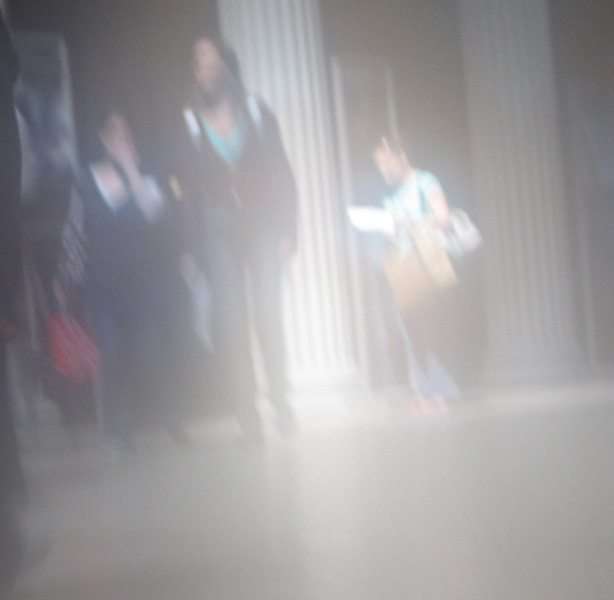
  In Max Dunlop’s painting of a NYC avenue we see the buildings themselves dance ( reminiscent of John Marin’s Woolworth building, a century before) and, all Max’s components blur in a seamless field of loose smudges. The effect is to render a lively motion. In the two photo examples, both by Max Dunlop, you can observe that Max’s low vantage point ( his camera is almost sitting on the street) and quick movement of the camera as he snaps the shutter evoke a sense of hurried motion. His capturing of the flags in motion reminds me of Monet’s example. We know flags are vulnerable to subtle air currents and, therefore easily accept their furious activity. Max’s lower our point of view in his photograph gives some curvilinear lens distortion furthering the sense of movement ( bend the ground plane and you evoke movement). In the final photo Max has breathed onto his lens then snapped his shot. The uneven obfuscating fog triggers a sense of subtle motion and ambiguous space. Here Max slightly tilts the picture plane to give a destabilizing sense of motion while the picture is anchored to a standard triangle as a compositional device.

Fredric Neuwirth
I was amazed to read that Max’s picture of a NYC Avenue was a photograph and not a painting. It has a very painterly look. I like it