I have long agreed with Ernst Gombrich that art , like science, at its best is an activity of pure discovery without an overt political, social or personal agenda.The artist disappears in the act of looking and finding. The musician disappears while performing the music. The scientist looks at the experiment surprised to see his plans, his biases refuted by the unfolding results. The authentic discovery is found, then shared but, only occasionally welcomed. I have eschewed politics inart as a poorly camouflaged effort to propagandize a point of view.The artist surrenders their perceptions in service to advertising rather than discovery.
Yet, art history shows these categories are not so easily separated. Certainly, Caravaggio’s choice to use a known Roman street prostitute as a model for Madonna in a painting commissioned by the church was a political gesture which aroused the predictable political reaction of censorship and rejection. Turner’s painting of “Election Day” revealed his political leanings. Pieter
Breughel’s landscapes with their irreverent and industrious peasants carried political freight. Constable’s celebrations of bucolic life in his personal arcadia, the Dedham Vale of England act as a quality of life rebuttal to the industrialization of English cities.
(example 1. Constable)
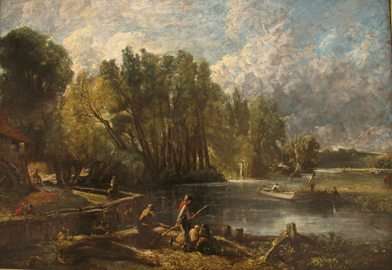
This image hardly appears political to us now. Politics and art are inseparable not because of the artist’s intention but rather, as a result of the direction of his attention and, what he finds there. In 1900 following in the social commentary tradition of Daumier, Kathe Kollwitz made disturbing images of human suffering.
(example 2. Kollwitz)
Art and politics became even more overt when prior to WWII George Grosz and Otto Dix commented harshly on the debauchery they saw in urban middle and upper class Germany. Retrospectively, we see their work as prescient of later moral depravity. The standard example of political repression of art by government comes from Hitler’s condemnation of art and artists for political reasons. Even Nazi sympathizer artists like Emil Nolde found themselves as stunned victims because, though their politics may have been Nazi their expressionist paintings were still considered degenerate. He was forced to stop painting in 1941. Here’s an example of Nolde’s politically offensive degenerate art which to us today appears politically inert.
(example 3 Nolde)
Other German Artists, like Max Beckmann, were censored not only for their expressionism, which was not overtly political except that it aroused the ire of the Reich but also, for his personal views. Beckmann discovered color, form, and design within the motif of savage cultural brutality . ( example 4 Beckmann) 
I didn’t feel political judgment from him as much as I perceived a passionate observation of the historic brutality of human culture. Here is an example of the blending of art and politics as a unitary expression. He was just looking and reacting to the social array which paraded before him and, to his gleanings from history. That’s what happened to me last week. As I wandered with my camera through Times Square I found myself on 42nd street in front a large cylindrical building advertising the NASDAQ, a word of symbolic potency in our time of economic distress. I was playing with angles with the camera as you see in the examples.
(examples 5,6,7) 


Later, in photo shop I began to play with the images of this intersection which resulted in the example #7. The first two photos are only what the camera caught. I discovered that the blue curving NASDAQ was a central motif which correlated to my thinking about markets; markets going up or down as visualized on a graph. My tilted view of the intersection appeared to offer coherence with such a market graph. My image had inadvertently acquired a political connotation as you see in this oil on linen painting.
(last example) .
.

jerry
I guess Guernica is the best example I know.