
Feel no surprise that even the greatest artists must refer to precedents and easily steal from them. The history of landscape painting is replete with examples. After looking at one of Titian’s reclining nude Venus paintings I noticed the landscape in the distance . I recognized it as a model for Rembrandt’s landscapes a full century later. I then considered
who did Titian look at and, who came before that. Vaguely mutating forms
travel through time to us like an image in a three-way mirror. The
first problem to arise was what evidence was there that Rembrandt looked at Titian. After all, Rembrandt never traveled to Venice. But, he did
collect prints and paintings of Venetian masters, especially Titian and, we know he had seen either this painting or a similar version by Titian which was owned by an Amsterdam
collector. According to Kenneth Clark, Rembrandt’s reclining Danae was based on
Titian’s reclining Venus. Here is Titian’s Venus with a Lute Player (now in the
Metropolitan Museum of Art.)
example 1.  Look closer at the detail example next.
example 2. Compare this landscape to the Jan Lievens (also attributed to de Villeers) 100 years after Titian.
example 3.  Compare the castle in the light, the alternating bands of dark and light, the series of silhouettes cascading from a series of peaks on the left. Next, compare the Titian to the following
Rembrandt landscape, also painted 100 years after Titian.
example 4. It’s even more like the Titian than the other. Even the plain spreading out on the right imitates the Titian. But where did Titian, a Venetian get his inspiration? He found it in other earlier Italians and Venetians like Mantegna and Giovanni Bellini. Their work is more linear and less painterly than Titian ( another quality imitated by Rembrandt). Here is a detail from a Mantegna painting (Agony in The Garden)with a similar mountain mass which again frames the left side of the painting and bathes the architecture in light. This painting precedes Titian’s by 100 years, about 1459-65.
example 5. Where do these mountains with castles in the light on the left of the painting start? I believe they begin in the 13th century
because, we can see evidence of a fresco by Simone Martini in early 1300s which
is over-painting an earlier fresco with a castle from the 1200s. Here is
Martini’s mural with its two castles and two hills framing the central rider, Guidariccio. You can see the partial and eroded earlier work below Simone Martini’s.
example 6.
Just like the later Mantegna and the even later Rembrandt we climb up the mountain along a serpentine route. When Rembrandt paints his famous and larger “Mill” (National
Gallery in Washington DC) he uses the same model but, swaps the castle in the sunlight for a Mill. The ascent is the same, a gentle curving path while the flattened plain to the right has now become serene water which is more reflective than a plain and helps to provide contrast against the dark hill.
example 7.
We all borrow from historical precedents. The better artist
has a vocabulary of more precedents from which to borrow. When my artist son, Max Dunlop, and I recently collaborated he borrowed Anselm Kiefer’s palette, his
simple “V” design (but, doubled it), and his expressive loose gestures of when starting this painting. I came in for the finish. First, I will show you the Anselm Kiefer from the Metropolitan Museum then, our painting.
example 8, the Kiefer.
example 9, us. 
Do you notice that our palette borrows from Rembrandt’s
“Mill”. Finally, I did not intend to reference Monet’s “Street with Flags”
painting but, I did in my most recent painting of NYC’s Times Square.
example 10 by Monet.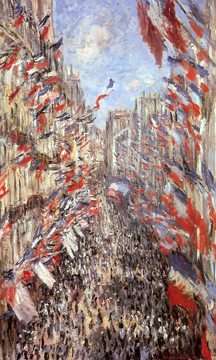
and, Times Square by me. example 11. .
.
Betty Rodgers
When will you be back on the Create Channel in Chattanooga, TN….I hope sooooon!