Patterns of dense textural intensity seduce us. In painting there is the perception ( real or illusory) that textured density requires much labor; and therefore, the greater the illusion of density the greater the perception of intensity and perceived value. If an artist can create an allusion to densely textured illusion then, our brain will correlate that painted textured flat field with a remembered (experienced) textured field such as a plot of turf, gravel, woven tapestry, the surface of a pond, or creased reflectant fabric. Imitating, mapping or symbolizing a remembered textured field is not necessary to trigger a response of recognition only making a texture which satisfactorily alludes to the texture of memory. Making such a texture is not a function of detailed imitation but rather, the result of experiments with paint, ink etc. textures which happen to offer a correlation to the remembered texture. As Da Vinci observed, ” The pursuit of detail hinders the experience of detail.” Detailed texture is the result of successful experiments in generating fields of texture which trigger recognition. The artist’s experiment at generating dense textures will be itself trigger the brain to try to read the painted texture of a chaotic field rendered within a rectangle as an enigmatic map of inscrutable variety. In the first and second decades of the 20th century Gustav Klimt toyed with flat patterns of complex and varied repetitive patterns, varieties within a coherent continuity(see example 1).  Other French artists such as Edouard Vuilllard ( and other Nabis painters) would continue to pursue the notion of flat variegated patterns suggesting wallpaper, fabric, or gardens( see example 2).
 By 1948 Lee Krasner, after exposure to Hans Hoffman’s push/pull theories of color, space, and abstracted shapes would invent a field of textural density to exceed Klimt’s, Klee’s and Vuillard’s work ( see example 3).
 I believe her work would influence the 1950 and later paintings of her husband, Jackson Pollock as he expanded the scale. His preferences for exaggeration, large formats, and a flair for the dramatic ( culturally inherited from not only His Oklahoma roots where the bigger the ranch the better but also, from his Missouri muralist teacher, Thomas Hart Benton) made him make bigger and more chance driven fields of texture. (see example)
 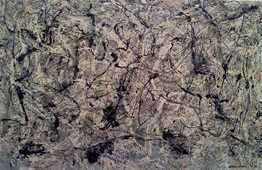 Pollock’s oversize flare for the dramatic would find favor in a culture that valued large scale, large ambition and big emotional gestures. Lee Krasner’s more intimate and constructed intellectual versions of textural density would not resonate as well in this culture. Others would follow ( Two new biographies of Joan Mitchell and Lee Krasner (author Gail Levin) have just been released and reviewed by Jed Perl in this week’s New York Times Book Review.) By the 1950’s abstract expressionists would pursue varieties of textural density through paint’s plasticity, thickness and its relationship to color. Toward the end of the century Anslem Kiefer and Gerhard Richter investigated the emotive effects of textured density, texture obfuscation through blurring and smearing, scale, the limits of textural variety and the limits of tactile relief effects. Here is Anselm Kiefer’s ” Bohemia Lives by the Sea”, a huge painting at least 8ft tall and 20 ft wide composed of oil, charcoal, and other elements. I also give you a side view of the painting to reveal its relief surface. ( see examples)
 There are other artists who were simultaneously pursuing texture and its ability to generate ambiguity in space as well as refer to marks on a flat field such as, the recently deceased Cy Twombly ( see example)
 Here are rows of automatic writing in layered linear perspective as if a landscape. Or, Bridget Riley who has pursued the brain’s conundrums with perceiving pattern densities as seductive teasers. In this next example in the 21st century is a contemporary Ghanaian artist, El Anatsui, who in 2007 created this enormous wall-hanging tapestry from bits of plastic and wire.(see example)
 Almost all of the art works I have discussed are on view now at the Metropolitan Museum in NYC except the Klimt and my last example. You and I are free to explore the possibilities of texture, perspective and ambiguity through music, taste, touch and vision. You and I can find aesthetic pleasure in surfaces we have generally ignored. We can find new narrative possibilities, new varieties of texture, new aesthetic triggers, new conundrums of perspective. This last example, a photo of mine, was just that. I found a soiled rectangular window with rusty streaks reflecting a patch of sky in the shape of a parallelogram, a distorted echo of the rectangle. the rusty streaks were made to converge like a perspective illuion by tipping the angle of the camera. The density and complexity of the textures will serve as a lure to our desire to unravel ambiguity.

JJane
Your way of talking about fields of pattern and texture and memory make me think of how art relates to eidetic memory – as a resource for the artist, and as a specific sensory experience of seeing that enables the transcendence of space. I love the Klimt, can you tell me where it is? Or where to find the image?
Bernie Rosage Jr.
David… will you be instructing at “Art in the Carolina’s” this November 2011 in Raleigh? I missed you last year and hope to be able to take your workshop this year if you are there.
Bernie
Deidre mannix
Hi David !
I just spent sat morning with you !!! Miss you abd can’t wait to get back in the painting saddle again !!! See you in Sept . So much fun to see the segment on Monet’s garden .
All the best
Deidre