Here is one of our brain’s strongest detectors of spatial location and, a tool for creating unity in a painting. You and I assume that an object in front blocks the view of an object behind. Hold up one hand to partially block your view of your other hand and consider that we generally perceive that the visually missing bit of hand has just been occluded or blocked but, continues to exist. This is the principle of occlusion or overlapping. It relies on the idea of implied continuity. An area that is partially occluded will appear to continue if it reappears in another are of the painting. And, any arrangement which is interrupted and begins again elsewhere in the painting we assume has a continuous relationship. This principle works in architecture, music, dance, everywhere. We assume continuity! Here is a still life from the 1600s ( example 1) The glue of continuity here is the darkness. The objects or facts ( baskets of fruit, flowers etc.) of the picture interrupt a sense of continuous darkness in their side by side arrangement. The enveloping darkness acts as a continuity behind the objects even where the objects block its appearance, just as the gray wall sits continuously behind its blocking foreground elements. The effect of unifying darkness is the root of chiaroscuro painting. The greater the sensation of continuity, the more the viewer perceives a sense of unity. We want to perceive continuities and, paintings, like music and architecture exploit our natural predilection for continuities. Young Monet offers us an impression of a bridge over water with clouds, foliage, a lady, a child, a foreground and background landscape ( example 2). Young Claude Monet failed to fully exploit the possibilities of continuity through occlusion here. The top of the foreground bush reaches up to but, does not block the view of the pillar supporting the bridge. The parasol also sits below the bridge when it could have also blocked pillar. Though, he does use the dark of the bush to propel the child and his light hat forward. The bridge itself continues uninterrupted across the painting surface cleaving the painting horizontally. These are opportunities lost due to youthful inexperience but, he will remedy them in later paintings as he acquires experience.
  .
. 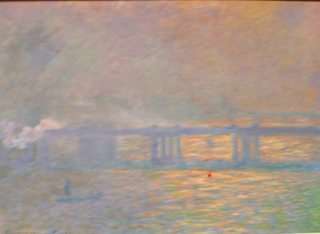 Thirty years later (example 3) Monet has learned that by a more continuous set of marks and, continuously graduating values and color and, slowly dissolving the edges he could enhance the continuity of the painted surface. He created a more unified feeling of light, a more unified atmosphere, a more united and spatially perceived space. Monet amplified unity through a variety of continuities. This time he uses a soft billow of pale smoke to interrupt the span of bridge and unite the two halves of the painting. In the early part of the 20th century Monet turned to his water garden for developing sensually unified paintings. He tried analogous color harmonies as a form of continuity( example 4).
 The colors and values are close here. His other continuities would come through the principle of occlusion (example 5 with diagram of purple lines outlining the reflected tree shapes) as the lily pad clusters overlap parts of the tree reflections. the tree reflections vertically unite the distant and near lily pad clusters. The arrangement of lily pad clusters themselves form an interrupted but, continuous serpentine shape. Because we manufacture the continuity of the shape (see the red diagram lines) as it recedes in linear perspective ( another form of continuity) we feel the unification of the painting the more we look at it. I have an example of my own work here ( examples 6 and 7 with diagrammed continuity lines).
 I have created a graduating color field which ( through our penchant to perceive continuity) appears to cover the entire area and, I have generated another form of continuity as Monet did by situating more defined shapes in an interrupted but, suggestively continuous pattern. Note: Last week we suffered technical difficulties posting the blog. This blog has been re-edited because, it was only up for about 12 hours before our technical knock out.

Connie Simmons
Another Excellent blog, David! I love reading all of your observations and insights.
Connie
Lorraine
This is a very mindful discussion on observation and application of how the viewer perceives the scene.
Fredric Neuwirth
David,
The linear diagrams are a great aid to understanding what you are writing about as it reinforces your thoughts. Since it only took Monet 30 years to improve it gives me hope!