The foundations for landscape painting and later modern abstraction were reset with new paradigms in the 1600s. The gestation period for modern abstraction would take 300 more years but, would be advanced by the experiments of three centuries of landscape painters. The Claudian model used by Turner, Constable and our Hudson River Painters can still be exploited by contemporary artists. Here is an example of Thomas Cole’s (see Met Museum, NYC) “Oxbow below Mt. Holyoke”of 1836 as a model for my painting of a valley at Abiquiu, New Mexico, Georgia O’Keefe’s valley. ( see examples 1 and 2).
 By looking back to the work of Jacob Van Ruisdael and Philip Koninck in the mid 1600s I found many examples to mine for compositional and lighting ideas. Their use of a lowered horizon with meandering pools of light through a darkened foreground served me as I painted other versions of the Abiquiu valley. ( see examples 3 Koninck, 4 Van Ruisdael, 5 Dunlop, 6 Dunlop)


 J.M.W. Turner would experiment with Van Ruisdael’s compositional structures as he tried eliminating the dark threshold of the foreground. He would let the viewer enter his painting with a fully illuminated foreground. Here was an idea that found utility in the later work of Richard Diebenkorn and Wayne Thiebaud. ( see examples 7 Turner, 8 Diebenkorn, 9 Thiebaud)

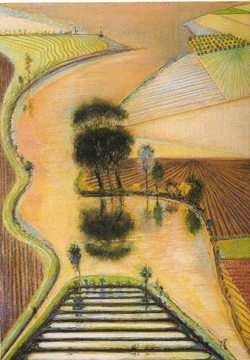 They would all continue to use the meander or a receding curving shape to deliver the viewer into deeper space. Additionally, Thiebaud and Diebenkorn would use the curve/meander to imply not only deep illusional space but also, imply the flatness of a map ( a reference to the physical flatness of a painting.) The curving shape unifies the picture plane whether its job was to provide perspectival space or a mapped idea of space. They also pushed Turner’s model of a brightly illuminated picture plane with increased brightening through a more complementary or neo-impressionist palette, Theibaud more than Diebenkorn. Diebenkorn would later drop the curving shape to emphasize the inherit flatness of the picture plane. I returned to the dramatic power of Van Ruisdael’s darkened foreground but, borrowed from them to generate a mapped as well as illusory space, as you can see in my blue view of Manhattan ( final example)
 . In this blog I have not discussed the design of the sky territory and its compositional relationship to terra firma, paint application, palette choices, or other matters so that I could focus on the influence of historical precedents in composing and lighting paintings.

Andy deBruyn
Van Ruisdael, Koninc and Turner’s pictures look like they could have been painted from a hillside or ridge whereas Thiebaud’s pictures look like he was much higher as in a helicopter or very tall tower giving them a much steeper angle/geographical (mapped) look. Which begs the question did he actually experience this viewpoint or did he use his imagination?
Roger Brown
Dave, Thanks. Perhaps I’ve missed something but the blog does not include your referenced “blue view of Manhattan”.
Best regards,
Roger
Fredic Neuwith
All of the ref. pictures have a light as well as lite quality. One of the aspects of coated watercolor paper ( for me ) the color gets heavy and dense instead of lite and fluid. Is there a way to control the water flow to create both lite & light watercolors? If so please show me how in the fall. I’ve only been able to do one painting like this at home after our Mead Park session & I think it was by happy accident. Thanks
Kay H
It is so illuminating to see antecedents and your way of synthesizing your ideas and experience.