
Picture a room. Before you are three walls, a floor and a ceiling. A window, a mirror or an open door are also present. Remember, a sky can substitute for the ceiling. These are the bones of multitudes of great paintings. From Diego Velazquez’s Fable of Arachne and Las Meninas (example 1) to Canaletto’s visions of Venice (example 2), the artist begins by building the space. The space is composed of trapezoids complying with the principles of linear perspective, conceptual mapping or a combination of the two. They frame the theme. They provide the context for discovering a story, a meaning.
Example 1, Velazquez, Las Meninas,

Example 2, Canaletto, St Marks Piazza,

In the 18th century Canaletto and other artists like Piranesi experimented with more complex verisions of the trapezoidal space. They called them invenzioni or capricci. Example 3 presents one of Canaletto’s inventions. Notice how he runs counterpoint diagonals (diagrammed in red) to the perspective receding lines (in green). As in “Las Meninas” we escape through a light door on the left.
Example 3. Canaletto, Capriccio,

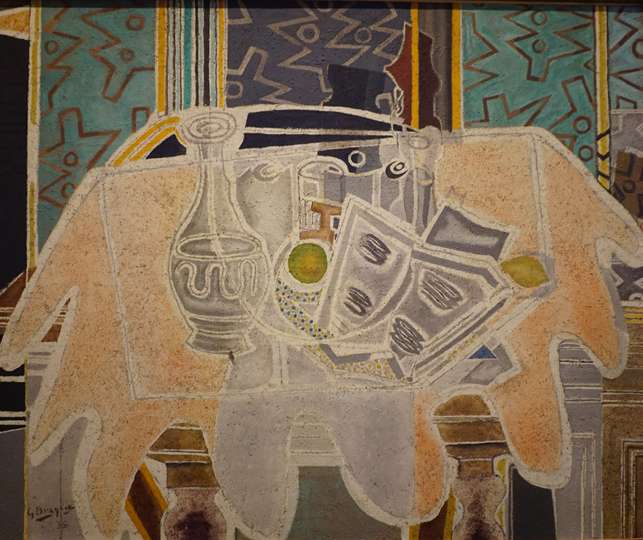
Early European depictions of events like the last supper often resulted in rooms which were carefully appointed but, the space did not credilby recede. Example 4 presents an illustration from Chaucer of a Pilgrims at a table. The table cannot accommodate all the pilgrims so it it tilts and floats above the floor and flattens against the picture plane. This conceptual way of mapping information in within the room (space) will be revised by Cubists like George Bracque (example 5).
Example 4. Illustration from Chaucer,1484,

Example 5. Georges Braque,
Cezanne,Bracque and Picasso inspired others to reconstruct space with multiple points of view and, using vision and memory as dynamic experiences. ( see example 6)
Example 6, L. Meidner, Cubist work, 1913,

Quickly, Abstract artists Like Popova and other Russian Constructivists would simplify and reduce the geometry of the picture plane. Velazquez’s trapezoidal room was deconstructed and reassembled with an eye to creating dynamic space, color and form relationships. The renaissance idea of “story” that had motivated the construction of the room was expunged by modernists ( example 7).
Example 7, L. Popova, abstract planes and shapes,

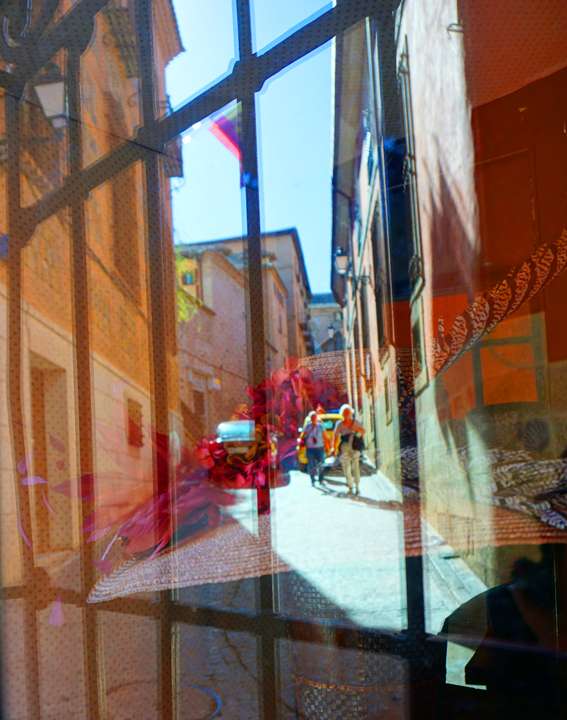
The “story” returned to the space by the mid 20th century but, artists maintained their interest in recombining and constructing spaces. Artists began to discover visual experiences in photography and paint that naturally reconstructed and defined conceptual space as can be seen in my photo in example 8. This image is not altered in any way from the way the camera discovered it.
Example 8, Photo of street reflections through barred window,
Twentieth century artists continued to explore he use of the room as Velazquez had done. The 20th century space could still folllow principles of linear perspective, still rely on an emotional narritive just as Vermeer had done but, the arrangement of forms became more distilled and abstract in feeling. Consider example 9 by Edward Hopper. See how he still creates credible perspective for a room, a stage just as Velazquez or Vermeer had done.
Example 9, Edward Hopper,

I diagrammed “las Meninas” (example 10) ; notice the diagonals using linear perspective. Also the luminous portals of mirror, window, and the door. The other portal or missing wall is where you, the beholder are standing. Just as in the Canalettos, the absent wall is an escape for the audience . It’s felt in every television sitcom or stage drama.
Example 10, Las Meninas diagrammed,

Just as so many other artists like John Singer Sargent, I borrowed from “Las Meninas” and “The Fable of Arachne” to construct my New York City street paintings. In example 11 you see how I built a glass ceiling over the Street. I expanded the sources of illumination. Example 12 provides a diagram which correlates to the classical model.
Example 11, Atrium Glass,

Example 12, Atrium glass diagrammed,

Just as Canaletto toyed with the arrangement of the room so did I in example 13. Additionally, like Canalettto I introduced diagonal counterpoint to the linear perspective lines of the room. You can refer back to this in Example 3.
Example 13, Madison and 57th, current state,

I can apply the Velazquez/Canaletto’s space making strategy to landscape if I depart from the rigid linear perspective construction of the room and make the space more elastic . Van Gogh makes a similar discovery as he undulates and curves the rigid geometry of linear perspective to suit a natural landscape shaped by agriculture and natural topography (example14). Van Gogh maintains the receding lines converging into the distance but now, our walls and flooring are biomorphic not architectonic. By becoming more and more elastic with the principles of linear perspective in building the floor of the space and allowing it to meander into a luminous distance an artist can still borrow from the tradition but, take greater liberties with rhythm and distance as see in my examples 15 through 16.
Example 14, Van Gogh, expressive geometry,

Example 15 presents a structured city landscape which I used as a substrate for the image in example 16. I vertically flipped example 15 before painting example 16 over it. I would harvest parts of the substrate with later deletions in my overlayer. Example 17’s diagramming demonstrates how I used the standard linear perspective to develop a stable floor and also introduced a serpentine meandering space. My paint application was deliberately noisy with many competing vertical and horizontal marks and shapes to add to the sense of nature’s commotion.
Example 15, City Landscape as substrate after vertical flip,

Example 16, Shorelines with expressive geometry,

Example 17, Shorelines with geometry diagrammed,

I invite you to join me on for my opening reception at the White Gallery on October 8th, 5-7 PM . My exhibit, “David Dunlop paints the northwest corner” runs from October 7th through November 26, 2016. The White Gallery is in Lakeville, Ct. at 342 Main Street, thewhitegallery@sbcglobal.net.
Nancy Hilden
I have been experimenting with a similar idea in a series of interiors. I’m happy to say I have had lots of positived feedback. I’m sure you have inspired me in recent months with your ideas of abstracting ideas. Thanks David.
Joan Zetka
This is one of the most worthwhile posts I’ve yet seen. It’s already a big help to me, as it brings back a lot of information I’ve managed to forget or ignore over the years.
Thank you, David.
Therese
The thinking behind the painting makes you think about the painting! Exquisite work David.
gailingis
I think I see how you pointed out the biomorphic walls in VanGoghs painting rather than seeing them as architectonic structures. It’s amazing to me your analysis to structure can be organic and still accomplish the goals pulling the eye into the painting to the luminous distance that is also organic in VG’s painting , or room so to speak. Even if I have doubts about my comprehension here, it teaches me to see further into how I see. I look forward to your discussion tomorrow to reinforce your thoughts here. Thanks David, for sharing your cerebral and artistic analysis.
Lorraine
Unfortunately I don’t live in your area to see your work. Excellent work. There is much to learn in creating art.
Maria D Sortino
Eres un gran maestro!!! muchas gracias!
Jerry
Excellent blog helping one analyze and understand artworks.
Krys Pettit
Thank you for this excellent refresher on perspective — always a bit tricky for me.
Roger Brown
Thanks for the fine instruction on space…always interesting and informative.
David G. Wallace
I enjoy the part on “Landscapes Through Time” where you take a studend’s painting and improve it. I suggest you do a series on PBS where people send pictures of their paintings to you so you could show how it could be made better. Of the thousands you could choose a few that demonstrate common mistakes.
Does anyone else like the idea? Send your comments to David Dunlop.
David
David, thank you for your thoughtful idea. It sounds interesting to me.