
When Dutch landscape painters designed their skies to unify their compositions they began with geometry. Using softened arcs, triangles and trailing serpentine forms they built coherent theatrical tableaus. Earlier in the 16th and 17th centuries El Greco and Venetians like Titian and Giorgione had experimented with distorted and exaggerated sky shapes to inflate the dramatic allure of the work.
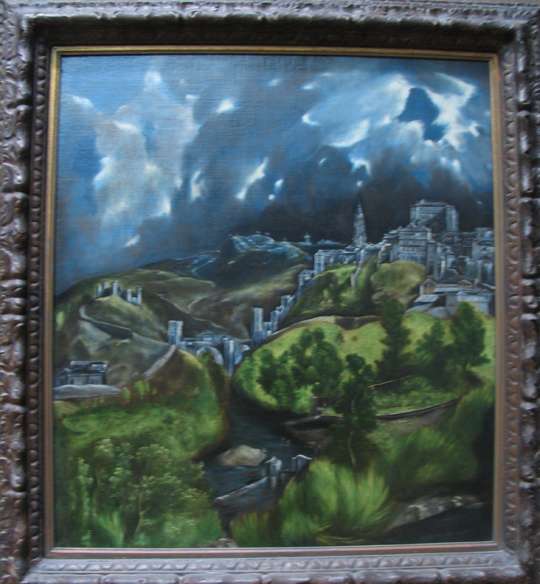
My first example is El Greco’s view of his adopted home, Toledo, Spain. Quickly you see how his landscape’s undulating trees and rhythmic buildings conspire with dancing gothic clouds to build a moving, unified effect. Artists would rediscover El Greco in the mid 19th Century probably through the visit of Manet to Spain. His expressive exaggerations seem to have influenced Van Gogh with his twisting celestial forms (example 2).
Example 1. El Greco’s View of Toledo,
Example 2. Van Gogh, Starry Night,

After re-examining the arching motions of El Greco’s Toledo I found I could apply his movements to a painting of marsh grasses (examples 3 and 4). Example 3 presents my first step, before the addition of atmospheric glazing above and darker glazes below (seen in example 4). Notice I reconstructed a romantic era sky in example 5 and, how my sky borrows the idea of an arching composition.
Example 3. Step one of my “Intimate Assembly” marsh grass.

Example 4 .Step two, after glazing.

Example 5. My Arching Sky in 19th century French Romantic Tradition,

By 1840 artists like George Michel were modifying the 17th century Dutch model. In example 5 see how he built a dark, serpentine set of connected clouds. Relying on perspective foreshortening as well as back lighting and atmospheric perspective, Michel built a deep and dynamic space (example 5).
Example 6. George Michel in 1840,

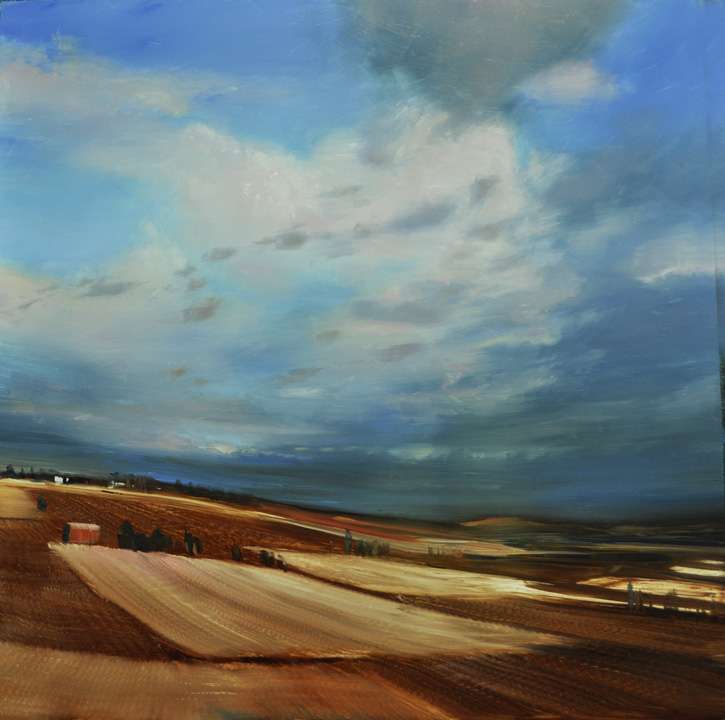
I began another sky and field landscape using the slow scooping foreground of Michel’s. I created a pattern of receding fields to augment the feeling of space generated by the sky. The painting is at a preliminary stage. I hope to show you its evolution later. For now, you can see my first steps in examples 7 and 8.
Example 7, Initial lay-in of color,

Example 8, the painting at present, an interim state.
gailingis
Welcome home! Glad you are here safe and sound. This is all so fascinating David. thanks for pointing out the geometric process.
Linda Marquez
Would you please share what products you use for glazing? I am fairly new to painting, about 2 years. I have seen reference to many different glazing products and am a bit confused as to which to experiment with first. Any of your expertise would be very appreciated.
Also, your video, Into the Woods, is my all time favorite painting lesson!
Sincerely,
Linda Marquez
Linda Hollett-Bazouzi
Wonderful article, David, and very useful information. Thanks!
Anna Mac
Ex. 8 looks terrific now!
Krys Pettit
Skies are fascinating — and never cease to inspire. Your explanations here are a great tool for those of us observing and hoping to capture nature’s ever changing artwork.
Thank you!
Fredric Neuwirth
#3 & #4 It would be helpful if you would do a blog on glazes. My guess is that the upper portion of the painting is either glaze in white or very pale blue. That the marsh grass is perhaps glazed in specific areas with ultramarine.
One thinks of a glaze as and application over the whole painting. But somehow I do not think so and It seems that it is specific.
Example #8 has great promise.
Shirley Howe
I also would love to see you do a blog on glazes!
Lawrence Stueck
I hope to see the finished painting you hope to show us.
Great Blog post
Arlene Oraby
Wonderful to see how your work connects to the old masters. I, too, would be interested in a blog about glazing. Your marsh painting is brilliant in its sense of intrigue, detail, and mystery.
Arlene Oraby
Therese
I like the interim state. It’s perfect as it is!