
Beginning in 15th century the Yuan Dynasty stretched for a hundred years. Yuan artists like Huang Gongwang painted vertically exaggerated landscapes of mountains, crags and valleys. Exaggerations like his were subsumed into American painting in the 20th century in artists like Diebenkorn and Theibaud. Artists, like actors and musicians favor simplification and exaggeration as devices to emotionally empower their art.
Example 1 offers a landscape of Gongwang’s. Example 2 presents a landscape of vertical exaggeration and simplification by contemporary artist Wayne Thiebaud. Observe the shared qualities.
example 1. Yuan Dynasty landscape.

example 2.Wayne Thiebaud cityscape.

Before Theibaud, Claude Monet tried luminous exaggerations with a vertical architectural motif. He painted at least 27 different versions of this Rouen Cathedral. The architecture dissolves into the eroding effects of sunlight (example 3). Following upon the work of Cezanne, Georges Braque simplifies and exaggerates architectural and organic forms in 1910 (example 4) as he presages cubism.
example 3. Monet’s Rouen Cathedral.

example 4.Georges Braque painting

I follow their lead but, I begin by digitally manipulating a photograph (example 5) which will serve as the substrate to two different images. One of these is a landscape, an autumnal stream. The other is a cityscape. The photograph is the result of manipulating an image shot within New York’s Grand Central Station.
example 5. NY GCS photograph.

example 5a. after vertical rotation.

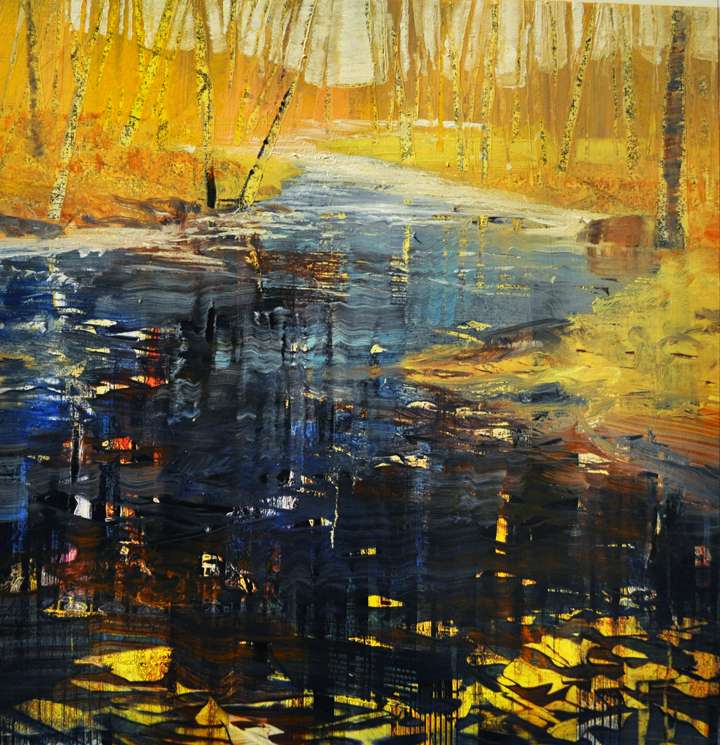
I printed two 13×13 versions of the photo. I heavily coated both versions with a polymer gloss varnish. After rotating it vertically (example 5a), I found the image to be a substrate capable of contributing to the creation of other overlaying images. I first over-painted the photo with an autumnal stream. Example 6 shows step one of an autumnal stream image. Look for traces of the original image as it contributes to the texture and appearance of the overlaying landscape. Example 7 presents step two in the development of the landscape over-painting. Observe how the textures of the trees borrow qualities from the floor the of the original photo. Notice how the original images dark figurative forms are subsumed into the dark water as dark vertical forms.
example 6. step one of the autumnal stream.
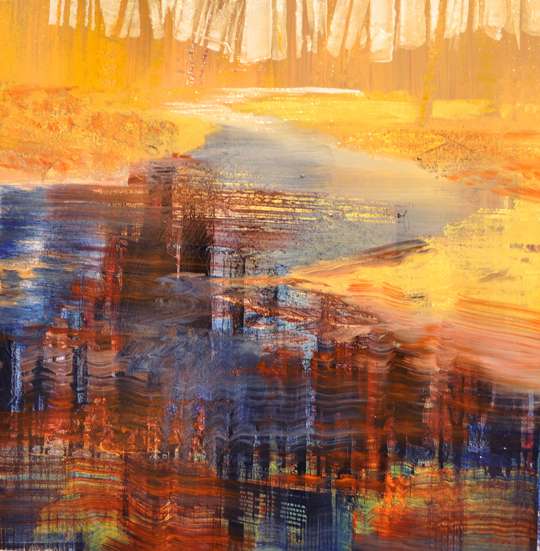
example 7. step two of the autumnal stream.
To demonstrate the versatility of the original photo as an influential substrate I over-painted it with a cityscape. Step one of this process can be seen in example 8. Step two can be seen in example 8. Both colors and textures of the original photo help contribute to the vertical variety and character of the image seen in example 9. Months earlier I painted another version of the same subject, a 24×24 oil on anodized aluminum which you see in example 10. Example 10 is straightforward painting, not an overlay on a photograph.
example 8. step one of the cityscape.

example 9. step two of the cityscape

example 10. original painting of the cityscape without a photo substrate.

dale
what program do you use to manipulate your photos? I have been wanting to break away from my tight style and this may be the inspiration for doing just that. Thanks you!
dale
David dunlop
Dale,
I use Photo Elements which is a less complex version of Adobe’s Photoshop . It is easier to use and, there are many helpful tutorials on YouTube .
Thank you, David
Gail Ingis
David, these examples are awesome images of how to utilize substrates of former paintings. It is fascinating how the dark figures were absorbed into the stream giving it depth and values. Your number ten painting is most appealing. Thanks again for sharing your amazing gifts.
Fredric Neuwirth
I am not sure I understand the relationship of your two paintings #6 & #8 in relationship to the vertical paintings of the Yuan Dynasty and Wayne Thebaud’s vertical city.
#6 & #8 are very effective. I am not sure how the Grand Central Station photograph underlay helped. I am sure you did not need them to make an effective painting. Unless of course they provided a visual idea or stimulation. I do think that they are more effective than #10.
Roger Brown
Thanks for this fine posting David. I spent much of this past Summer painting large canvases…8′ x 6’…( in my new Lyme, Connecticut studio) with the main intent being to explore verticality in landscape. I concluded that I might advance my cause by starting with a 2 dimensional substrata over which I’d paint the deep space landscape I had in mind. I began by masking out a random set of vertical rectangles, to my liking, and then applied a transparent red oxide wash, in oil, removed the tape and when dry applied a second, lighter wash. The result was endless possibilities to create structure in and around the forms. As the deep space painting developed, I selectively painted out the now shadowed lines but left a few as “noise” strengthening my verticality objectives.
I think this method, that I worked out as a “way forward”, is very much along the lines of your digitally manipulated photographs serving as substrata. Interestingly, my son posted one of my initial, smaller efforts 37″ x 55″ “Alaskan Glacier Fields” in my Instagram account earlier in the evening and there is an earlier posting of a large work “Till the cows come home” ( 5 weeks ago) should anyone wish to have a look.
Thanks and Best Regards,
Roger Brown
David dunlop
Roger,
How are you listed on Instagram?
Thanks, David