
From Monhegon Island’s pristine forest trails to Maine’s inland coves, artists have expressed their experience of deep forests with textured shadows and scattered pockets of light. These expressions can be distilled emotional evocations tucked into subtle designs. Last week I brought artists to these locations. We set out our easels, palettes, bug spray and sunscreen. In the future I will show their work from Maine’s rocky promontories but, this week we return to the woods. These woods are backlit by the glare off saltwater coves. Here we found the essence of dense forest life without chasing sharp-edged realism. Instead we looked to evoke the sensation of visually scanning the infinite textures of a forest.
First, let me show a photograph of our general area ( example 1) . Our view is through trees along the water’s edge. I began with plein air demonstrations. First I painted with acrylics which I later overlaid with oils (example 2). In my second demonstration (example 3) textures were generated by spritzing a spotty rain of turpentine over the wet oil paint . The fracturing effects of the turpentine into wet oil offer a suggestion of the fine and varied textures of a forest interior.
example 1. photo of the area.

example 2. plein air demo in acrylic with oil overlay.

example 3. plein air demo in oil with turp. spritzing.

Several of my artists took up the challenge of deep forest painting. Example 4 by Kathryn Poch presents a 12×12″ oil on white anodized aluminum. She used a combination of squeegees and wide, soft flat brushes. Kathryn blurred her squeegee marks with brushes which gave her work a vaporous luminosity. You see her work on the easel with the woodland behind.
example 4. Kathryn Poch’s plein air oil.

What follows are two different studies (each 24×24) developed in the studio using photographs of the same woodland ( see example 1). Each image proceeds similarly at first but, with a different older painting serving as the substrate or underpainting. Example 5 (step one) is a marsh painting turned on its head. I proceeded to example 6 (step two) which reflects my design’s simplified intention. Example 7 reflects my pursuit of a feeling of motion in the forest, the motion of my eyes and head turning as I looked around. Here, The painting was further layered, blended, squeegeed, brushed, and feathered.
example 5. step one, the inverted substrate.

example 6. step two, early design.

example 7. step three, latest developments.

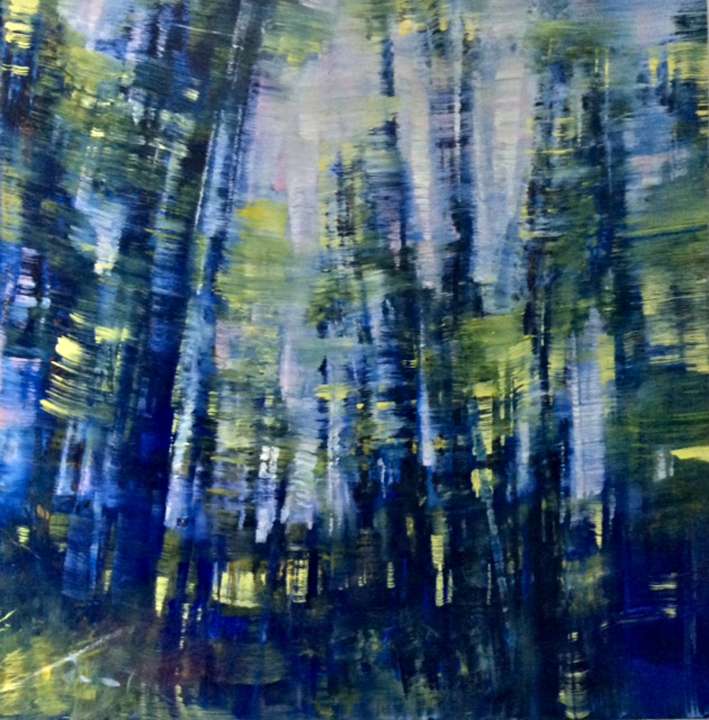
The second study used a different painting, an inverted Parisian cityscape. You can detect its reddish color under my initial squeegee marks in my overlaying coat of ultramarine blue (example 8). In example nine I again tried misting turpentine into the paint. The effects were curious but ultimately, unsatisfactory. I returned to brushwork. You can see the results in example 10.
example 8. step one, the initial lay-in with squeegee manipulations.
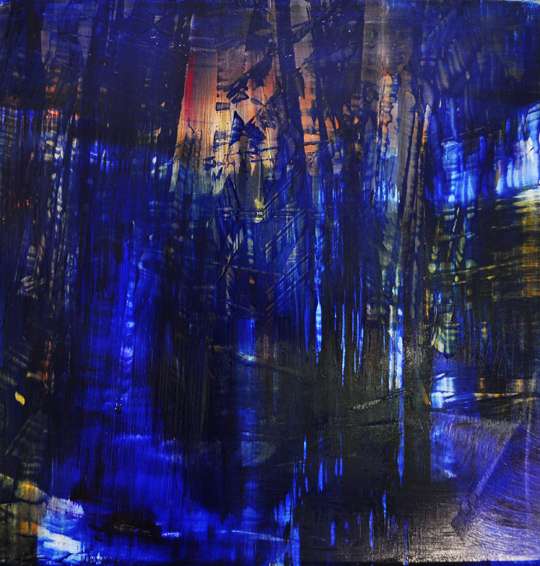
example 9. step two, after turp spritzing.

example 10. step three, the return to brushwork.
Gail Ingis
Great explanations and visuals. The first turp spritz was acceptable, the second turp reminded me of raindrops on my oil painting, also unsatisfactory. Thanks for sharing Katherine’s painting and process. I have never been to Monhegan Island. It’s a must go, isn’t it?
loretta
See, there’s no accounting for taste, I love #9 with the spritzing…..
Fredric Neuwirth
We were at Mohegan Island in early June and enjoyed its beauty and tranquility. Example #3 the turpentine spray is very effective and give the foliage texture and depth. I would like to see a larger picture of Kathryn’s painting as I am not clear about the red slash but I am intrigued . Example #8 looks like it has great possibilities with the red glow but I am not sure of the final direction with glow gone.
Gail Tarrantts
Number 9 looks like it could be water reflections. Very interesting!
Sylvia keller
Interesting application of Turpentine Spray!
I also do my underpainting with Acrylics by applying Rustoleum Spray Paints before overlaying it with glazes of oil. It worked well and looked great, but after a year of drying the oils cracked and the picture self destruct.