
As a boy I marveled at acetate overlays in encyclopedias and anatomy books, how one image printed onto transparent acetate could add complexity when overlaid with another. Printmakers use this process. Print an image then rework the plate or the screen and add it to the original, slowly an image is built up, deepened with layers. Like my mother’s layer cakes, she would split each pan’s cake with a knife then frost it and add it to a stack. Slowly the cake rose like an office building under construction. The layers were the key to complexity and key to attracting my attention and appetite.
When paintings or photographs are built in layers we perceive them as have a greater sensation of depth. Mystery is heightened by ambiguity and further heightened by complexity. It’s the difference between hearing 30 barely distinguishable whispers and one. We will reach for more possibilities in the crowd of whispers. We will guess and reach certainty earlier when only one barely distinguishable voice is present.
In the first example, an oil on aluminum 36×36 “Transparent Botany” ( example 1) I first created a tableau of pattern with translucent oils. I let that dry. I then added more opaque layers but deleted select areas to reveal the more translucent and reflective strata below. Within a thin film of paint an illusion of depth and complexity is stimulated by the effects of this contrast between the opaque and the translucent. Dissolving clouds of paint (edgeless opaquely glazed areas) obscure the divisions between opaque and translucent areas further enhancing uncertainty and the illusion of space. Example 2 is a detail from example 1.
Example 1, “Transparent Botany”
Example 2. detail area.
The following examples are a step by step demonstration of my building the transparent layer cake. I use a set of brushes ranging from 8″ wide to 1 ” wide soft flats ( see example 3). I also use a 6″ squeegee. I begin with a painting (example 4) I had made earlier. I now planned try a larger version from 36×36 to 48×48. I also wanted to try spot lighting sections of the surface layer. Initially applied a blurry and variegated base across the painting. Then I removed small bits of paint ( smaller in back and larger in front) in an overall meander with a 6″ squeegee (example 5). Next I blended the squeegee marks. Then, I added opaque marks over the blurred substrate (example 6). I did not completely obscure the previous layer ( see detail example 7). In the next step I blurred areas of the opaque additions ( example8). Each action appears to add another layer of complexity.
example 3. brushes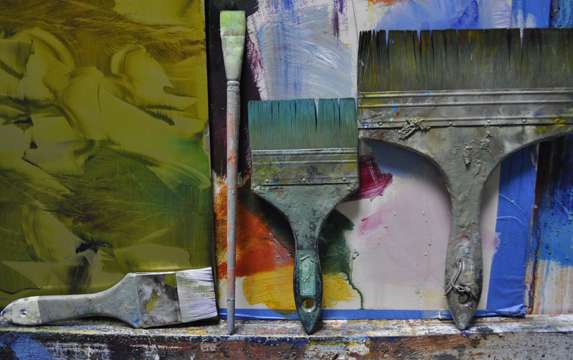
example 4. 36×36 version
example 5. step one
example 6. step two
example 7. step three, detail from step 2
example 8. step four
Watery subjects lend themselves well to layering. We experience a pond in layers, first the surface and it’s reflections then the submarine layer. Cities too can be expressed through layering ambiguity whether the subject is vertical like the buildings or horizontal like the street. Here is an example of ambiguous layering of a city subject.( examples 7 ). In example 7 the substrate is brushed gold enamel which acts a reflective undercolor.
example 7. “Fast City”
Elaine
would love to see you do this in class.what about doing it on layers of velum?
Gail Ingis
David, your metaphor is wonderful, “Slowly the cake rose like an office building under construction.” My compliments to you… the layering of your paintings are equally wonderful. Your work has always exemplified the layering technique.
Fredric Neuwirth
” Transparent Botanty” I assume this has already been glazed, some paint removed to increase the high lights and depth of the ultramarine.
Example #4 has very reflective yellow pattern with high lights.
Example #5 is this paint now the 48 X 48 version? and is infact a new painting of the same subject? If it is then the nice & appealing aspect of example #4 got lost. The reflective bright yellow has morphed into a more specific area. It is hard to appreciate the changes and to understand at blog scale.
Jennifer Richard-Morrow
Very glad to see you will be back in Greeville for a workshop next summer! Can’t wait!!!
Judy Cline
David, does this layering method work as well on other surfaces besides aluminum? I expect you will demo this process at the Arts of the Carolinas in Raleigh in November. Besides water, does this technique work well for other subjects?
Jill
Thank you David,
You reminded me of those wonderful acetate overlays that I delighted in as a child. Two of my paintings where I used layering to build up the translucency of the water have been getting much attention lately. I had already decided that its time to do another painting that way. Thank you for all of your step by step tips of how you got your beautiful results. I have a piece of aluminum that I just might try it all out on….
Regards, Jill
William Child
Seeing the depths into water as in a pond, is why I usually prefer regular or u.v. clear glazing for my framing customers. I tell them, unless you can’t see the picture where you want to hang it in your space because of reflections, the clear glass (regular glass is 40% u.v. protectant, u.v. clear 99%) the reason low reflection glass does what it does is to diffuse the light reaching the glass and will also diffuse the clarity of the image below. Sometimes low reflection which also comes in u.v. is the best choice. In some cases diffusing an art image might enhance it? I almost never recommend low reflection for a shadow box presentation. Looks like the art is disappearing in a fog sometimes.
But I tell people clear glass is like a still pond surface allowing great clarity of seeing the colors and lines involved below. All glass darkens a piece slightly. Museum glass is expensive and does a nice job of eliminating glare, at some angles it looks like no glazing was used, but I don’t think they have perfected the product, “seeing”, ha ha, as its surface is very easily scratched especially by the framer, and oils from fingers etc are labor intensive to remove, on both sides. Museum acrylic is even more expensive but easier to handle.
Lawrence Stueck
Your mom would be very proud of you. Thanks for the details on your painting magic.
Kay Halcrow
Glazing layers has a number of aspects — both in creating a 3rd dimension, and perhaps even in capturing a 4th dimension – time – which can be thought of both like an archaeological stratification or layering or in a different sense, as motion (time as motion through space). Just as the antiquarian looks at an old piece of furniture and sees what happened to it through many years. Or as the blurred image of people or fish suggest motion. Definitely creates uncertainty and mystery.