
Anywhere I look is a consequence of my expectation, even when I am surprised. I still search the sky for a jet plane with difficulty because, I look to where the sound is coming from. It’s where my brain initially signals me to look. But the sound doesn’t keep up with the visual location of the jet. I realized I have to look along the trajectory of the sound, in front of the sound if I wish to find the jet. My expectations were mistaken. When we look at the world we re-create it as a 3D experience in our brains. We receive visual cues which tells us which object is front and which is in back, which is over and which is under. These cues are vital for artists make a flat panel feel like a 3D panel. Many books from “Perception: Theory Development and Organization” to “How The Brain Works” give simple examples of these cues. Below are examples of some of these cues and paintings that use them to create 3dimensional illusions.
Artists use the way we categorize to make illusions because, we categorize everything from smells to sounds to sights to touches. One basic form of visual category is that of “similarity”. We like to associate things that are alike. We even prefer to associate with people with whom we feel a shared similarity.
Example 1 illustrates how we group by similarity in geographic space. We identity groups on their similar geographic proximity and other similarities. In example 2 you see how we group according to geometric similarities. There are countless ways of identifying and arranging groups of similarities. But, we have a system of priorities when we do this grouping. In example 3 you see two groups arranged by geographic similarity and then subdivide into geometric similarity. In example 4 you see a single shape which forms its own group which we can describe as something like an almost closed letter “C”. In example 5 you find a cluster of these incomplete circles with their interrupting breaks coming at different points and sizes. Your new category is that they are all circles, just careless or incomplete circles. No more letter “C”. Objects get their identities from their group. You can subdivide them into other similar groups forming vertical or horizontal groups of three. Look back at example 2 and see that not all the square shapes are completely joined but, you grouped them with the other squares anyway. All these similarities have been grouped in the same spacial plane.
example 1. group by geographic similarity 
example 2. group by geometric similarity 
example 3. subdivisions of similarity 
example 4. singular identity 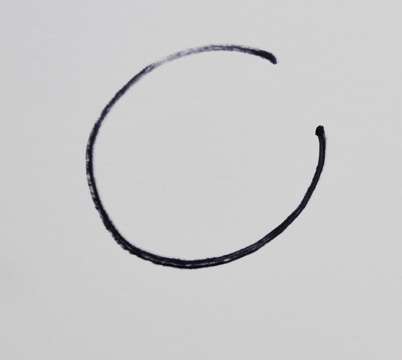
example 5. identity through group similarity. 
We also perceive extended distributions of similarities and create a unified continuity. Finding the Big Dipper star formation in the night sky is an example. We favor grouping in lines and curves no matter how severe the interruption. See example 6.
example 6. extended continuity grouping 
We find space when two groups appear to overlap. In example 7 is the example of the overlapping. We presume that the triangle is blocking our view of a unified rectangle. That places the triangle in front. We also group by orientation or common direction as seen in example 8. When two directions overlap or conflict we separate them in layers of space. One direction is above the other. And, if you take the shapes in example 2 and let them overlap our brain will decide which group lays on top of the other as you see in example 9. In example 10 I have an example of work by Neil Welliver. The Trees and their reflections are grouped as verticals with a common direction while the water shows horizontal grouping. The conflict between group directions helps create a sense of space just as the overlapping of the trees over areas of water allow us to create an illusion of space for the location of areas of the water.
example 7 Overlapping 
example 8. grouping by direction with and without overlapping 
example 9.Two groups overlap 
example 10. Welliver painting. 
In examples 11 and 12 notice how I changed the original painting’s sense of unity, motion and space (example 11 ) by invoking an additional layer of blue-green (example 12) which is subdivided in with the common grouping system. I added (in example 12) other fish to extend the sensation of continuity with multiple possibilities as opposed to the more singular direction in example 11. In example 13, I overlapped vertically oriented groups with horizontally oriented groups as well as making different group color similarities (fish) and group geometric similarities (cut outs in the the blue-green).
example 11. original fish painting 
example 12. altered fish painting 
example 13. Reflections and Shadows 
The next examples demonstrate grouping verticals against horizontals and also using the principle of overlapping, color graduation , and group shape shifts to create a sense of space. In both examples 14 and 15 I have groups that mutate their group shape identity through through continuity. Similar dark solid shapes get smaller, paler and more fractured along a continuity.
example 14. City In Blue 
example 15. City in 3 sections 
William Child
Love this blog segment! If there is a science to better appreciating what and how we see, interpret and feel about the world, this kind of investigation is right on the mark.
Fredric Neuwirth
#10 The Neil Welliver painting is a bit of a stretch; I see the verticals and the veticals in the reflection but not in the water. Perhapsit is clearer in the original.
#11  The blue green additon adds to the movement and emphasizes the grouping of the leaves.
#13 The vertical reflections add a lot of motion, a lot of space; it is very effective.
#14  These are your best city paintings so far. What is intersting is the developmemnt over time of an idea. These paintings are dynamic in the verticals and horizontal elements, the perspective adding deep space & color. Theuy are great!
Tamera
Hello!
Objects are not the only thing that get their identity from their group but its the contrasting element that makes it sublime.
Oh, by the way, please send original fish painting #11 immediately (I don’t think I should be forced to live without it).
Thanks!