
Our ability to recognize and build patterns is our essential motivator in perceiving and constructing art, let alone everything else from finding our keys to the finding the door. We use each of our senses as if it were a telescope, a single probe antennae. We know where to look, to reach, to touch, to listen on the basis of our ability to seek and find patterns and, detect their interruptions. We pay attention to the interruptions in patterns. We ignore patterns that flow without distracting variation. This is how we spend our lives. It’s why we stop at traffic lights. In painting we want to create patterns that unify a small defined territory of the visual field. We know where to look in the visual field because of cues like a rectangular shape as an anomaly in the visual field cues us that we are looking on a wall toward a window or a picture. We find places that are preselected for garnering our attention , like this computer screen. We attend to patterns only when they are interrupted. Interruptions are breaks of surprise; they are the variety that captures us. The pattern and the spacing of interruptions, and the scale of the interruptions, the intensity of the interruptions all join to attract and sustain our attention.
Art, Architecture, Music and all other constructions depend our how we recognize patterns and their breaks. They depend upon our predisposition to organize similarities into groups and, the feeling of satisfaction we receive by this act of ordering. Anomalies, variations in the pattern cause us to ponder their meaning. We guess how they fit into the pattern. Everything must fit into a category. It’s how our mind is constructed. When we make anything we use pattern. We use the simplest forms of geometry to construct our patterns. That makes them easier to read and to spot meaningful variations. In painting if a pattern is too chaotic we will not recognize it as meaningful. That is, it does not contain a variation from the discernable pattern. The aberrations in pattern are what we call information. A painting needs a pattern and an interrupting series of variations into which the viewer can guess at a possible meaning or at a variety of meanings. Too much variety and we lose attention. Too little and we lose attention. First let me show you a chart of one way in which we construct organizing patterns. We group similarities.
example 1. 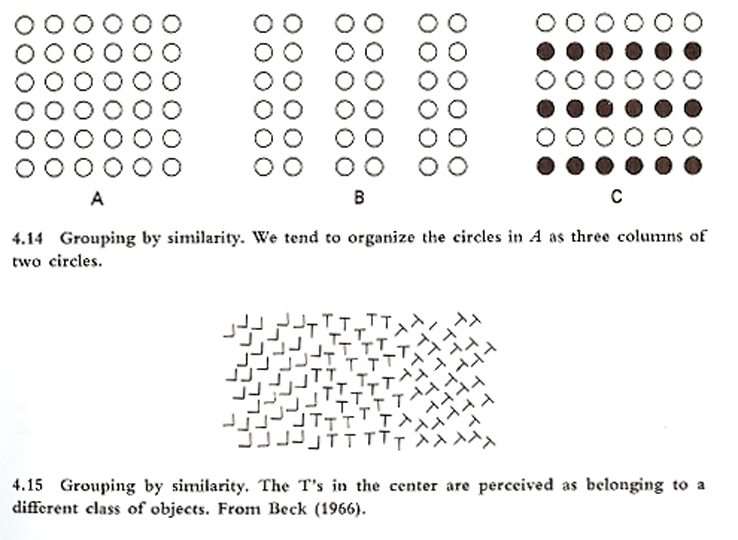
Bridget Riley toys with our penchant for recognizing pattern by giving us patterns of great similarity so that we try to tease out variations from an overly obvious pattern. The density of her patterns can frustrate our efforts and beguile them as well.
example 2 and 3 ( Bridget Riley) 

In the following examples of my own work I have a painting which was not unifying well because the patterns were too distributed and disconnected ( example 4). I later ( example 5) applied a solution of pattern simplification to the work to build unity while sustaining variations in the pattern. This was my an effort to sustain the attention of the viewer. If the simplicity of the pattern is more obvious then the variations become more meaningful.
example 4 and 5. 

In my next example, I inverted the triangle or letter “A” as the unifying pattern which will hold the disparate medley of parts together. The disparate background medley ( a phrase of Gombrich) is of sufficient variation to suggest a natural arrangement of rocks or leaves under translucent reflective water.
example 6. 
I have just begun a landscape with a variety of patterns. Hopefully, they are not too complex which could frustrate your effort at discovery and guesses at meaning. I used art historical precedents( patterns ) for cuing you to look into this painting, this rectangle. I begin with dark at the bottom and gradually let the painting get lighter toward the top. I use larger shapes which graduate upward into smaller shapes. Edges of the foreground shapes are more clear than the upper most shapes in the light area. The pattern of light and dark shapes moves in a broken triangle or arrow pointing up into the picture ( or back into the metaphorical pattern).
example 7. 
If you are interested in further reading on this subject I suggest Ernst Gombrich’s The Sense of Order or, Richard Gregory’s The Eye and The Brain.
Nancy Reinker
David, I’ve discovered that I am almost automatically grouping elements of my complex drawings into compositional clusters and using space as the counter balance. Is this intuitive? I’ ve never tried to put it into ‘words/explanation’ but it seems to feel like such a natural response to the imagery.
David Dunlop
Nancy, yes it’s intuitive for us to group and isolate ( or create space for the autonomy of the category). Interestingly, the ancient Chinese artists referred to the system as substance/absence . All space they saw ( as we do) divided into something/nothing. or, As Miles Davis said, It’s not just the notes, it’s the space between the notes that counts.
Dave Gehman
Interesting how this cuts both ways — until you poke at… sever… alter certain patterns, your brain (left to itself) leads your hand to inject repetitive patterns (tree A looks like tree B which looks like tree C). “Drawing on the Right Side of the Brain” illustrates the differences between pre-patterned perception and actual observation. And history has seen many painters who create flat planes when planes in gradations, variegations, broken color are more interesting. Maybe art is the art of making safe the tremble of the tiger just before it springs toward you…
Connie Simmons
All of you are very poetic! How fun to read this!
Trish
This message is for David.
I couldn’t wait to tell you how much I enjoy your landscape painting DVD’s. No matter how much I read, it has never been so plainily explained as seeing you perform the painting and techniques on screen. I love your sense of humor and you make the experience so much fun. Thank you, thank you, thank you!
Trish